
During the Pandemic Housing Boom, surging housing demand, ultra-low mortgage rates, and rapid home price appreciation pulled a wave of home flippers into the market, as short hold times and rising values made quick resales highly profitable. Today’s environment looks different, but it has also become more selective. Borrowing costs are higher, and price growth has moderated across much of the country, placing a greater emphasis on disciplined underwriting and operational execution.
Number of home flips in the U.S. by quarter
Even so, market conditions remain favorable in a subset of metro areas—largely smaller Midwest and Northeast markets—where home prices are still rising, inventory remains constrained relative to pre-pandemic levels, and recent flip performance suggests that well-structured deals continue to pencil.
To identify the best markets for home flipping in 2026, LendingOne evaluated the following data for 180 metro area housing markets:
- Year-over-year change in home prices between December 2024 and December 2025, according to the Zillow Home Value Index
- Year-over-year change in active housing inventory for sale between December 2024 and December 2025, as measured by our analysis of Realtor.com data
- Active housing inventory for sale at the end of December 2025 compared to December 2019, as measured by our analysis of Realtor.com data
- The typical gross profit on home flips in Q3 2025, according to ATTOM Data
- The typical gross return on investment (ROI) on home flips in Q3 2025, according to ATTOM Data
LendingOne’s methodology is rooted in a simple premise: markets where inventory remains meaningfully below pre-pandemic levels and home prices are still rising are more likely to support price stability and resale demand during a flip hold period. To validate this framework, we also examined recent flip profitability to ensure these markets are not just theoretically attractive but also practically viable.
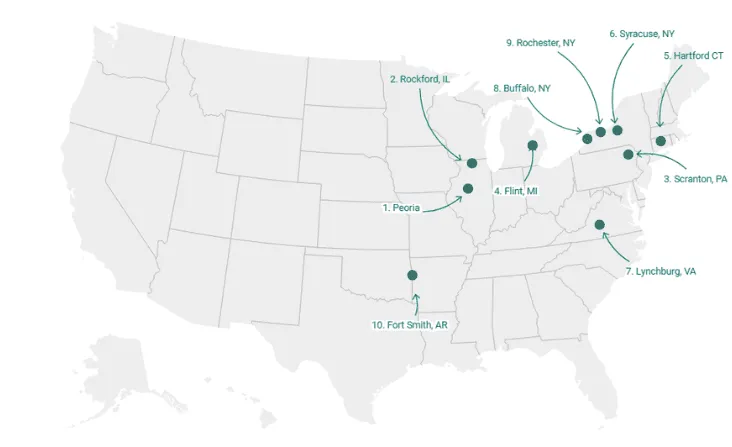
Let’s take a look at the top 10 markets for home flippers in 2026.
Top 10 best home flipping markets for 2026
#1 Peoria, IL

Typical home value in December 2025: $161,212
Year-over-year home price change: +8.6%
Typical flipping gross profit: $56,250
Gross ROI: 73.8%
Inventory compared to pre-pandemic 2019 levels: -14.7%
Peoria ranks at the top of the list thanks to a rare combination of strong price appreciation and high flipping returns. Home prices rose nearly 9% over the past year, while inventory remains below pre-pandemic levels, helping support resale pricing. For flippers, Peoria offers a classic Midwest value profile: low acquisition costs, an aging housing stock, and enough demand to sustain attractive exit spreads.
#2 Rockford, IL
Typical home value in December 2025: $205,334
Year-over-year home price change: +8.0%
Typical flipping gross profit: $62,500
Gross ROI: 54.3%
Inventory compared to pre-pandemic 2019 levels: -40.5%
Rockford combines fast home price growth with deeply constrained inventory. Active listings remain roughly 40% below 2019 levels, tightening competition for move-in-ready homes. That dynamic continues to translate into strong flipping margins, particularly for investors targeting affordable entry points outside the Chicago metro.
#3 Scranton–Wilkes-Barre, PA
Typical home value in December 2025: $218,596
Year-over-year home price change: +3.4%
Typical flipping gross profit: $104,500
Gross ROI: 104.0%
Inventory compared to pre-pandemic 2019 levels: -46.0%
Scranton remains one of the strongest risk-adjusted flipping markets in the country. Inventory is nearly 46% below pre-pandemic levels, and typical gross profits now exceed $100,000. The metro’s highly affordable housing stock and large share of older homes continue to create fertile ground for value-add renovations.
#4 Flint, MI
Typical home value in December 2025: $183,404
Year-over-year home price change: +5.2%
Typical flipping gross profit: $63,304
Gross ROI: 72.3%
Inventory compared to pre-pandemic 2019 levels: -50.1%
Flint pairs solid price growth with severely constrained inventory. Active listings are roughly half of what they were in 2019, tightening supply for renovated homes. For flippers, Flint offers low basis, strong ROI, and consistent buyer demand for updated housing.
#5 Hartford, CT
Typical home value in December 2025: $376,811
Year-over-year home price change: +4.8%
Typical flipping gross profit: $131,950
Gross ROI: 55.4%
Inventory compared to pre-pandemic 2019 levels: -72.9%
Hartford stands out for the severity of its inventory shortage. Listings remain nearly 73% below pre-pandemic levels, among the tightest conditions nationally. Even with a relatively high typical home value of $376,811, that scarcity has helped support strong resale pricing and six-figure flip profits. For experienced, well-capitalized flippers, Hartford’s combination of constrained supply and steady price growth continues to create attractive opportunities.
#6 Syracuse, NY
Typical home value in December 2025: $245,913
Year-over-year home price change: +4.4%
Typical flipping gross profit: $97,000
Gross ROI: 70.3%
Inventory compared to pre-pandemic 2019 levels: -49.4%
Syracuse continues to benefit from tight supply and steady demand. Inventory remains roughly 50% below pre-pandemic levels, creating pricing power for renovated homes. Combined with an aging housing stock, the metro remains a strong market for value-add strategies.
#7 Lynchburg, VA
Typical home value in December 2025: $274,091
Year-over-year home price change: +1.0%
Typical flipping gross profit: $158,500
Gross ROI: 130.5%
Inventory compared to pre-pandemic 2019 levels: -12.5%
Lynchburg stands out for outsized flip returns. Typical gross profits exceed $150,000 and ROI tops 130%, despite only modest price growth. These results suggest deals in Lynchburg are being driven primarily by basis and renovation execution rather than market appreciation.
#8 Buffalo, NY
Typical home value in December 2025: $270,322
Year-over-year home price change: +3.7%
Typical flipping gross profit: $122,300
Gross ROI: 94.1%
Inventory compared to pre-pandemic 2019 levels: +44.5%
Buffalo is an outlier on inventory, with active listings above pre-pandemic levels. Even so, recent flip data shows strong profitability, reflecting low acquisition costs and buyer demand for renovated homes.
#9 Rochester, NY
Typical home value in December 2025: $260,900
Year-over-year home price change: +2.8%
Typical flipping gross profit: $95,500
Gross ROI: 64.9%
Inventory compared to pre-pandemic 2019 levels: -60.1%
Rochester remains deeply undersupplied relative to 2019, helping support resale pricing even as price growth has moderated. The metro continues to offer a compelling combination of affordability, tight supply, and strong flip margins.
#10 Fort Smith, AR
Typical home value in December 2025: $194,831
Year-over-year home price change: +3.6%
Typical flipping gross profit: $68,500
Gross ROI: 50.2%
Inventory compared to pre-pandemic 2019 levels: -60.2%
Fort Smith rounds out the top 10 with solid price growth and extremely tight inventory. Active listings remain about 60% below pre-pandemic levels. For flippers, Fort Smith offers low entry costs and consistent demand for renovated housing.
Big Picture
Home flipping in 2026 is increasingly a market-selection and execution-driven business. The strongest opportunities are clustering in smaller Midwest and Northeast metros where housing remains affordable, inventory is constrained, and recent flip data confirms that value-add strategies can still generate attractive returns.

