
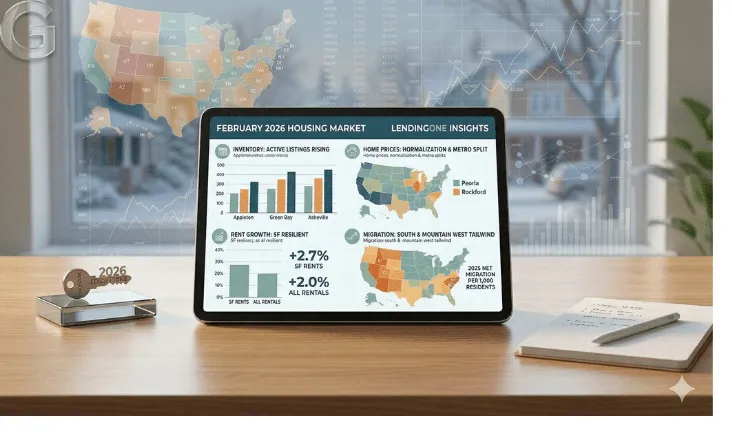
Table of Contents:
In February 2026, the first full read on the year ahead’s housing conditions is starting to come into focus—and the signal is clearer than the noise.
The broader backdrop remains familiar, but increasingly actionable. Inventory has been rising across many markets, home price growth is highly local and uneven, and rent growth has cooled from pandemic highs but remains positive—especially for single-family rentals. In other words, this is still a market where investors need to be selective, but it’s also a market where better entry points are becoming easier to find.
The key is not trying to force a single national narrative. It’s identifying where supply is building, where pricing is holding, where rents are still compounding, and where migration flows continue to support long-term demand.
Every month, investors are hit with a flood of new housing market data to consider. Each data point helps paint a picture of the current state of the U.S. housing market, but there are a few signals that are essential for savvy real estate investors to pay attention to.
To cut through the noise and help you stay up to date on what’s happening in today’s housing market, here’s LendingOne’s February 2026 market recap.
Inventory: Active listings are still rising, but the pattern is highly local
As 2026 gets underway, housing inventory continues to edge higher across much of the U.S. The post-pandemic buying frenzy has given way to slower sales and year-over-year gains in active inventory levels in most markets.
National active listings in January 2026 were 10% higher than the year before. Still, active inventory levels were -18% lower than they were in pre-pandemic January 2019. The uptick highlights that conditions have eased somewhat over the past year, even as supply remains historically constrained overall.
12-month change in active housing inventory for sale: Shift between January 2025 and January 2026
In several supply-heavy markets, builders are still using incentives and price cuts to move product, which has pulled some demand away from existing homes and helped push resale inventory higher.
The result is a market that looks less frozen than it did a year ago—and more workable for buyers and investors who are staying selective.
Among the largest 200 metros, these are the five with the highest year-over-year inventory gains relative to January 2025:
- Appleton, WI: +66.4%
- Green Bay, WI: +58.7%
- Asheville, NC: +58.2%
- Roanoke, VA: +48.1%
- Fayetteville-Springdale-Rogers, AR: +42.8%
Investor takeaway: Investors are entering 2026 with more negotiating leverage and better deal selection in many markets, but success will depend on targeting metros where rising inventory reflects normalization—not weak underlying demand.
Single-family home prices: cooling further under the weight of affordability pressures
The metro price chart is a good reminder that home price performance is now much more fragmented than it was during the boom years. Some metros are still posting strong annual gains, while others are clearly in reset mode. That split is exactly what investors should expect in a market where affordability pressure, inventory normalization, and local income growth are doing more of the pricing work.
Nationally, single-family home prices were flat from January 2025 to January 2026, up just +0.3% compared to a 4.0% gain a year earlier.
The national story is one of normalization: price growth has slowed materially as elevated mortgage rates and affordability constraints keep gains in check, but values have also remained relatively stable at the national level. In other words, while the era of broad, rapid appreciation has cooled, the market is still holding up—especially in areas where supply remains tight.
One-year change in single-family home prices by metro
Most of the strongest gains are concentrated in the Midwest and Northeast, where relatively lower levels of pandemic-era new construction and sustained demand have helped support prices even in a higher-rate environment.
These are the top 10 U.S. metros for year-over-year single-family price growth:
- Peoria, IL: +8.6%
- Rockford, IL: +8.2%
- Appleton, WI +6.8%
- Utica, NY: +6.7%
- Duluth, MN +6.0%
- Flint, MI: +5.9%
- Green Bay, WI: +5.8%
- Youngstown, OH: +5.7%
- Erie, PA: +5.3%
- Norwich, CT: +5.3%
Investor takeaway: National appreciation is no longer doing the heavy lifting, so returns will depend more on market selection—especially targeting metros where supply remains relatively tight, and price stability is holding.
Rent growth: National rent growth remained positive to start 2026, with single-family rents still leading multifamily
The national rent-growth chart shows the same core story investors have been watching for months: cooling has continued, but conditions remain relatively stable.
As of January 2026, national rent growth was still positive, with single-family rent growth remaining the most resilient:
Single-family rents: +2.7% YoY
All rentals: +2.0% YoY
Multifamily rents: +1.4% YoY
Year-over-year shifts in U.S. rent growth
That’s a slower pace than a year earlier, but it’s also not a collapse. For investors, the key read-through is that rental demand is still there—especially in single-family—while affordability pressures in the for-sale market continue to support the renter pool.
Investor takeaway: Rent growth has cooled from the pandemic-era surge but remains positive—especially on the single-family side—so the opportunity in 2026 is less about betting on fast rent spikes and more about targeting markets where steady rent growth and disciplined acquisitions can still produce solid returns.
Single-family rent growth: the strongest gains remain concentrated in the Midwest and Northeast
Single-family rent growth is still a regional story with many of the strongest gains concentrated in the Midwest and Northeast. Among the 50 largest metros, Cleveland (+6.3%), Indianapolis (+5.7%), Providence (+5.5%), Kansas City (+5.4%), St. Louis (+5.2%), Chicago (+5.1%), Pittsburgh (+5.0%), Richmond (+4.6%), and Cincinnati (+4.6%) all posted stronger-than-national rent growth.
In many of these markets, relatively affordable rent levels, steady local demand, and more limited new supply have helped support firmer rent gains.
By contrast, several large Sun Belt markets are still seeing positive rent growth, but at a slower pace. Austin (+0.7%), Las Vegas (+1.0%), Phoenix (+1.1%), Dallas (+1.2%), and Houston (+1.3%) are all up year over year, but well below the national pace. In these markets, a larger flow of new housing supply and more price-sensitive renters have kept near-term rent growth more subdued.
Even so, slower growth doesn’t mean weak fundamentals. High home prices and elevated mortgage rates are still keeping many households in the renter pool, including in single-family rentals, which should continue to support demand as markets work through new supply.
Year-over-year shifts in single-family rent growth
Investor takeaway: Single-family rent growth in 2026 is still there, but it’s increasingly market-specific—so investors should prioritize metros where rent growth is outperforming the national pace and supply pressure is more manageable.
Single-family permits cooled in 2025 but remained above pre-pandemic levels
With the November and December 2025 residential permit data now included in this month’s release, the full-year construction picture is in.
According to LendingOne’s analysis of U.S. Census Bureau data, the U.S. issued about 907,100 single-family permits in 2025—down 7.6% from 2024, below the 2021 post-pandemic high—but still above 2019 levels. That’s a useful mix of signals for investors: builders pulled back from the faster pace of recent years, but activity remained relatively solid by pre-pandemic standards.
In other words, 2025 looked more like a normalization year than a sharp contraction. Builders were more selective, but they were still active in markets where demand and margins supported new projects.
U.S. single-family permits issued annually
Investors should keep an eye on markets where construction has moderated without stalling and be more cautious in pockets where new supply is still arriving faster than local demand can absorb it.
Domestic migration: the South and Mountain West still have the tailwind
Domestic migration remained a key housing demand driver in 2025, with the strongest inbound moves concentrated in the South and parts of the Mountain West, while several higher-cost coastal and northern states continued to post net domestic outflows.
Migration helps shape the housing demand base over time. When a state is consistently attracting residents from elsewhere in the U.S., it can support household formation, rental demand, and homebuying activity—even when affordability and mortgage rates are pressuring the market nationally. It also helps explain why some markets hold up better than others during slower periods.
To make the comparison more apples-to-apples, LendingOne analyzed net domestic migration per 1,000 residents, rather than just raw headcount.
That matters because a smaller state can have a much bigger migration impact on its housing market than a larger state, even if the total number of movers is lower. In other words, this view helps show where migration is most meaningful relative to the size of the local population.
Net domestic migration in 2025 as a ratio per 1,000 residents
The Carolinas stand out, with South Carolina ranking first on a per-capita basis and North Carolina also landing near the top of the list. Idaho remained another notable migration leader, underscoring that the Mountain West is still attracting residents even after the pandemic-era surge cooled.
Investor takeaway: States with sustained inbound moves often have a stronger long-term housing tailwind, but the best investor setups are where that demand growth is paired with balanced supply and steady rent performance.
Big Picture
As the first housing data of 2026 is released, our analysis points to a housing market that is rebalancing, with inventory rising, price growth cooling, and rent growth remaining positive—especially for single-family rentals.
For investors, that creates a more workable environment than a year ago, with better deal selection and more room for disciplined underwriting, but also a greater need to be selective at the metro level.
The clearest opportunities in 2026 are likely to be in markets where supply is normalizing, rent growth is still holding up, and migration trends continue to support long-term demand.


