
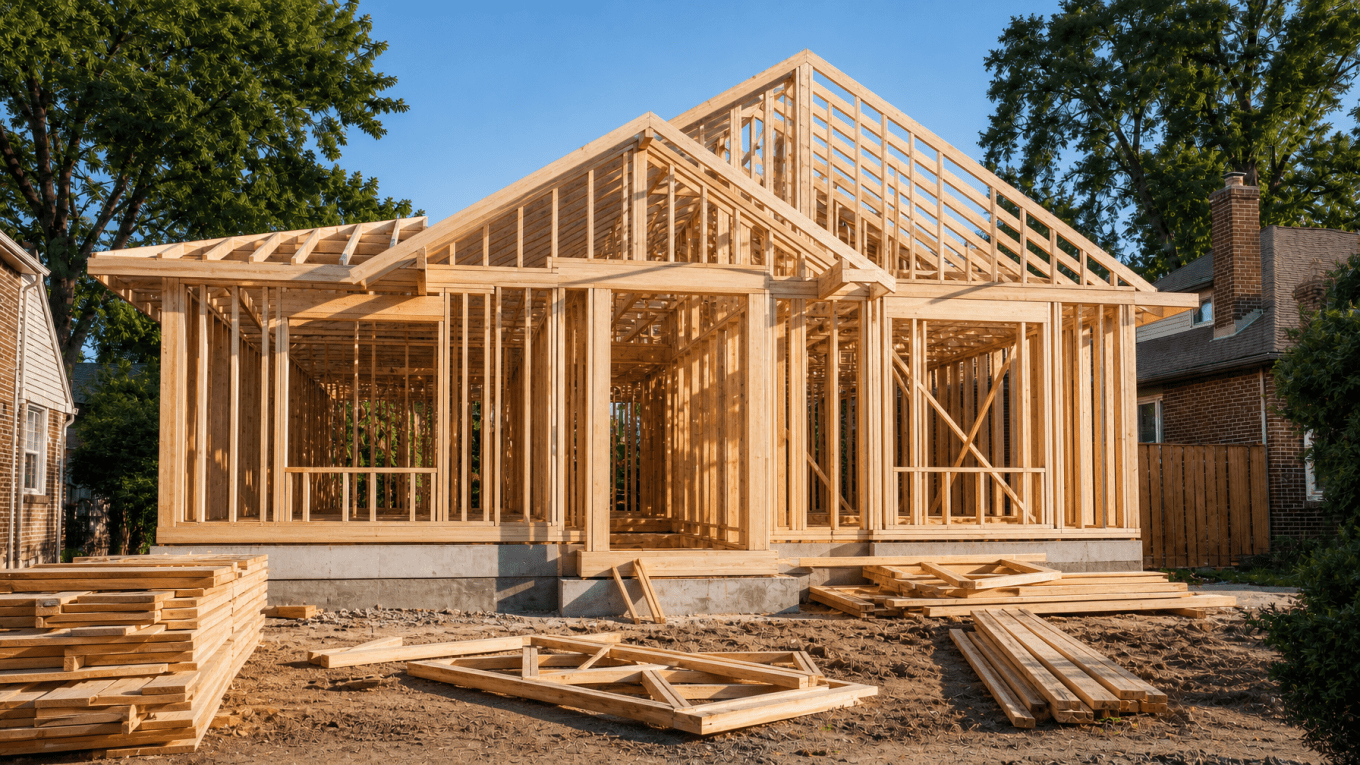
Single-family housing starts fell to 808,000 (seasonally adjusted annual rate) in July 2026, down 9.9% from June and 15.7% from a year earlier, according to the U.S. Census Bureau. At the same time, building permits rose 5.0% month-over-month to 1,443,000, the clearest signal that builders are holding entitlements while waiting for demand to catch up.
That gap between permits filed and projects started is where the opportunity sits. Builders who can move on entitled lots with the right financing structure are positioning for the next cycle while others wait on the sidelines.
This guide covers how new construction loans work, what they cost, how bank and direct lender financing compare, and how to structure your exit, whether you plan to sell, rent, or build for investor buyers.
Table of Contents
- Key Takeaways
- How New Construction Loans Work
- The Draw Process: How Funds Are Released
- Bank vs. Direct Lender: A Side-by-Side Comparison
- New Construction Costs by Market in 2026
- Three Exit Strategies for Completed Construction
- What Lenders Require to Qualify
- How to Transition from Flipping to Ground-Up Construction
- Frequently Asked Questions
Key Takeaways
- New construction loans are short-term (12-24 months), interest-only loans that fund land acquisition and building costs through a staged draw process. You only pay interest on the amount drawn, not the full commitment.
- Bank construction loans offer lower rates (8-9%) but require more documentation, personal guarantees, and typically cap at 75% LTC. Direct lenders like LendingOne go up to 90% LTC with faster closings and no interest on undrawn funds.
- The cash-on-cash difference is dramatic: on a $450,000 project, a 90% LTC direct loan requires $45,000 in cash versus $112,500 at 75% LTC from a bank, nearly tripling your cash-on-cash return.
- Your exit strategy determines your loan structure. Build-to-sell uses a standalone construction loan. Build-to-rent should plan for a construction-to-DSCR refinance.
- In August 2026, 63% of builders are using sales incentives and 35% are cutting prices, per the NAHB/Wells Fargo HMI. For spec builders who can manage costs tightly, less competition at the start line means less competition at the finish line.
How New Construction Loans Work
A new construction loan funds the building of a residential property in stages. The lender commits a total loan amount based on the project's costs and projected after-completion value, then releases funds incrementally as construction milestones are completed and verified.
This structure differs from a fix-and-flip loan in three ways:
- Longer timeline. Construction loans run 12-24 months versus 6-12 months for a flip.
- Staged funding. Funds are drawn in 4-6 stages as inspections pass, rather than a single lump sum at closing.
- Interest only on drawn funds. You pay interest only on the capital that has been released, not the full loan amount. On a $400,000 commitment where $150,000 has been drawn, you pay interest on $150,000.
Loan Terms at a Glance
| Feature | Typical Range |
|---|---|
| Loan term | 12-24 months |
| Payment structure | Interest-only on drawn funds |
| LTC (loan-to-cost) | 75-90% depending on lender type |
| ARV cap | 65-75% of after-completion value |
| Loan amounts | $200,000 to $40,000,000+ |
| Interest rates | 8-13% depending on lender and borrower profile |
| Origination | 1-3 points |
| Draw schedule | 4-6 draws typical |
The Draw Process: How Funds Are Released
The draw process is what makes construction loans unique. Instead of receiving the full loan amount at closing, funds are released in stages as the project progresses through verified milestones.
Typical Draw Schedule
- Initial draw at closing. Covers land acquisition, permits, site work, and initial soft costs.
- Foundation draw. Released after the foundation pour and inspection pass.
- Framing draw. Released after framing, rough electrical, and rough plumbing are complete.
- Mechanical/systems draw. Covers HVAC installation, electrical finish, and plumbing finish.
- Final draw. Released after certificate of occupancy or final inspection.
Each draw requires an inspection confirming the work is complete before funds are released. The speed of that inspection process varies significantly between lenders.
Why Draw Speed Matters
A slow draw process creates cash flow gaps that force builders to float contractor payments out of pocket. If a framing crew finishes on Tuesday but the lender's inspector can't get to the site until the following week, the builder carries that cost for 7-10 days.
LendingOne's virtual draw process lets builders submit draw requests with photos from a mobile app and receive funds in as little as two days. That speed difference, compounded across 4-6 draws, can mean weeks of saved interest and smoother contractor relationships.
Bank vs. Direct Lender: A Side-by-Side Comparison
This is the most important decision in new construction financing. The rate difference between banks and direct lenders is real, but it tells only part of the story.
A direct lender like LendingOne controls all funds and underwrites every loan in-house, with no middleman, no broker markup, and no waiting on a third party to approve draws. That direct control translates to faster closings, faster draws, and a single point of contact from term sheet to final draw.
| Feature | Bank Construction Loan | Direct Construction Lender |
|---|---|---|
| Interest rate | 8-9% | 9-13% |
| Maximum LTC | 70-75% | Up to 90% |
| Cash required ($450K project) | $112,500 (at 75% LTC) | $45,000 (at 90% LTC) |
| Closing speed | 30-60 days | 10-21 days |
| Income documentation | Full: tax returns, financials | Minimal to none |
| Draw inspection | In-person, bank-scheduled | Virtual option available |
| Personal guarantee | Required | Varies |
| Multi-project capacity | Limited by balance sheet | Portfolio-based underwriting |
The Cash-on-Cash Math
The rate difference matters less than most builders expect once you factor in leverage:
| Metric | Bank Loan (75% LTC) | Direct Lender (90% LTC) |
|---|---|---|
| Total project cost | $450,000 | $450,000 |
| Loan amount | $337,500 | $405,000 |
| Cash from builder | $112,500 | $45,000 |
| Total interest paid (12 months) | ~$14,300 | ~$20,100 |
| Sale price (ARV) | $600,000 | $600,000 |
| Selling costs (6%) | $36,000 | $36,000 |
| Net profit after all costs | ~$101,000 | ~$95,000 |
| Cash-on-cash return | 89.8% | 211.1% |
The bank loan costs $5,800 less in total interest. The direct lender requires $67,500 less cash upfront, more than doubling the cash-on-cash return. For a builder running multiple projects simultaneously, that capital efficiency determines how many deals they can have in the pipeline at once.
When a Bank Loan Makes More Sense
- You have one project at a time and excess capital sitting idle
- The project timeline is flexible and a 45-60 day close doesn't cost you the lot
- You can provide full income documentation without complications
- The rate savings on a single large project outweigh the leverage advantage
When a Direct Lender Makes More Sense
- You run multiple projects simultaneously and need capital efficiency
- A lot is under contract with a tight close deadline
- Your income documentation is complex (self-employed, entity structures, multiple LLCs)
- You need the flexibility to scale from one project to three without re-qualifying
New Construction Costs by Market in 2026
Construction costs vary significantly by geography. These ranges reflect hard costs only (materials, labor, permits). Add 15-25% for lot acquisition, soft costs (architecture, engineering, surveys), and contingency.
Cost Per Square Foot by Market (2026 Estimates)
| Market | Cost/Sqft Range | Typical Spec Home Size | Total Build Cost Range |
|---|---|---|---|
| Houston/DFW | $120-$160/sqft | 1,800-2,400 sqft | $216K-$384K |
| Atlanta | $130-$170/sqft | 1,800-2,200 sqft | $234K-$374K |
| Tampa/Orlando | $140-$180/sqft | 1,600-2,200 sqft | $224K-$396K |
| Charlotte/Raleigh | $130-$165/sqft | 1,800-2,400 sqft | $234K-$396K |
| Phoenix/Tucson | $135-$175/sqft | 1,600-2,200 sqft | $216K-$385K |
| Nashville/Chattanooga | $125-$165/sqft | 1,600-2,200 sqft | $200K-$363K |
What's Driving Cost Increases in 2026
Three factors are pushing construction costs higher:
- Tariff-related material price increases. Lumber, steel, and electrical components are all affected by current trade policies. Builders report 5-12% increases on framing packages compared to early 2025.
- Labor shortages in skilled trades. Framers, electricians, and HVAC installers remain in short supply across Sun Belt markets, adding both cost and scheduling uncertainty.
- Insurance. Builder's risk insurance premiums have risen 20-40% in Florida, Texas, and coastal markets since 2024, adding $3,000-$8,000 per project in markets like Tampa and Houston.
The builders still breaking ground profitably in this environment share a common approach: locked material pricing before breaking ground, reliable crews under contract (not bid-to-bid), and conservative ARV projections based on 60-day comps.
Three Exit Strategies for Completed Construction
Your exit strategy should be decided before you close on the construction loan, because it affects everything from property design to financing structure.
1. Build-to-Sell (Spec Home)
Build, complete, list, sell. The most straightforward exit. Start marketing 60-90 days before completion to minimize holding time between CO and closing.
Best for: Markets with strong buyer demand and limited standing inventory. In August 2026, 63% of builders are using sales incentives per the NAHB, so pricing competitively from day one is critical.
Design considerations: Build to the market's sweet spot. In most Sun Belt metros, that means 3BR/2BA, 1,600-2,200 sqft, open floor plan, with finishes that photograph well but don't price the home out of the primary buyer pool.
2. Build-to-Rent (BTR)
Build, complete, lease, then refinance into permanent DSCR financing. The construction loan converts to a 30-year rental loan based on the property's rental income, not the builder's personal income.
Best for: Markets where rent-to-price ratios support a DSCR above 1.0 on the completed property. Many Sun Belt and Midwest markets pencil for BTR at current construction costs and rental rates.
Design considerations: Durable finishes over trendy ones (LVP over hardwood, quartz over marble). Lower-maintenance exteriors. Layouts that maximize rental appeal: separate laundry, ample storage, at least one full bath per bedroom.
LendingOne's construction-to-DSCR refinance lets builders transition from the construction loan to a long-term rental loan with a single lender, eliminating the cost and delay of a second origination.
3. Build-to-Sell to Investor Buyers
Construct spec homes designed specifically for investor buyers who will purchase with DSCR financing. This exit targets a different buyer pool than traditional spec: investors evaluating cash flow, not homeowners evaluating countertops.
Best for: Markets with strong rental demand where investors are actively acquiring. The product is a rental-ready home: 3BR/2BA, 1,400-1,800 sqft, durable finishes, and a price point that supports positive cash flow for the end buyer.
Advantage: Investor buyers are less rate-sensitive than owner-occupant buyers. They evaluate returns, not monthly payment affordability. In a market where 35% of builders are cutting prices to attract rate-conscious homebuyers, selling to investors can produce faster exits.
What Lenders Require to Qualify
Qualification requirements differ substantially between banks and direct lenders. Here's what each typically evaluates:
| Requirement | Bank Typical | Direct Lender Typical |
|---|---|---|
| Cash reserves | 6-12 months PITIA | Varies, often none at closing |
| Down payment | 25-30% of project cost | 10-25% of project cost |
| Experience | Varies widely | 1+ ground-up project in 36 months |
| Documentation | Tax returns, financial statements, personal guarantee | Simplified, entity-based |
| Appraisal | Required | Required |
| Scope of work | Detailed line-item budget | Detailed line-item budget |
The Experience Requirement
Most direct construction lenders require at least one completed ground-up project within the past 36 months. This is the most common barrier for flippers transitioning to new construction.
If you lack recent ground-up experience, two paths can help:
- Partner with a licensed general contractor who has a verifiable track record of completed projects. Some lenders will consider the GC's experience alongside the borrower's.
- Start with a significant rehab that involves structural work (additions, foundation work, full gut renovation). While not identical to ground-up, it demonstrates the project management skills lenders want to see.
For experienced builders running multiple projects, LendingOne's new construction team provides portfolio-based underwriting that accounts for your full track record, not just the most recent project.
How to Transition from Flipping to Ground-Up Construction
Many successful flippers eventually move to new construction for larger per-project profits and more control over the finished product. The transition requires planning:
Step 1: Build Your Team First
Before your first ground-up project, assemble:
- A licensed general contractor with completed ground-up experience (if you're not a GC yourself)
- An architect or draftsperson for plans and engineering
- A surveyor familiar with your target market's lot requirements
- A title company that handles lot closings and new construction
Step 2: Start with Infill
Single-lot infill projects in established neighborhoods offer the most forgiving entry point. The lot is already entitled (or close to it), infrastructure exists, and comps are abundant for ARV analysis.
Step 3: Scale Deliberately
The jump from one infill spec to a five-lot subdivision involves a different level of capital management, entitlement risk, and construction scheduling. Most builders run 2-3 successful single-lot projects before scaling to multi-lot developments.
Step 4: Match Your Financing to Your Growth
As you scale, your financing needs change. A single spec home might work with a bank construction loan. Three simultaneous projects require a lender that can underwrite your portfolio of work, not just an individual project.
Talk to a new construction loan advisor →
Frequently Asked Questions
How long does it take to close a new construction loan?
Banks typically take 30-60 days. Direct lenders can close in 10-21 days. The speed difference matters most when a lot is under contract with a hard close deadline, or when a builder needs to start before material pricing locks expire.
Can I use a new construction loan for a multi-unit project?
Yes. Most lenders finance 2-4 unit residential properties and townhome developments. Larger projects (5+ units, subdivisions) are available through lenders with institutional capacity. LendingOne finances new construction projects from $200,000 to $40,000,000+, covering everything from single infill lots to subdivision developments.
What is construction-to-permanent financing?
A "one-time close" that combines the construction loan and permanent mortgage into a single closing. This product is primarily available through banks for owner-occupied properties. Investor projects typically use separate construction and DSCR loans, which often produces better terms on both sides because each loan is optimized for its specific purpose.
How do construction draws affect my interest costs?
Because you only pay interest on drawn funds, your effective interest cost during construction is significantly lower than the stated rate suggests. On a $400,000 loan at 10%, your first month's interest might be $2,500 (on the initial $300,000 draw) rather than $3,333 (on the full commitment). As draws progress, the interest charge rises. Most builders budget interest costs at roughly 60-70% of the full loan amount times the annual rate, divided over the construction period.
What happens if construction takes longer than expected?
Most construction loans include extension options (typically one to two 3-month extensions) for an additional fee, usually 0.5-1.0 points per extension. Building in a realistic timeline with contingency from the start is less expensive than paying extension fees. Weather delays, permit issues, and material lead times are the most common causes of overruns.
How do I estimate my total project cost for underwriting?
Start with hard costs (materials + labor + permits), then add soft costs (architecture, engineering, surveys, insurance, closing costs, interest carry), then add 10-15% contingency. A common mistake is underestimating soft costs, which typically run 15-25% of hard costs on top of the construction budget.
Talk to a new construction loan advisor →
Last updated: August 2026

