In the ever-evolving landscape of real estate, the quest for favorable deals has intensified, particularly as home prices and mortgage rates reach unprecedented levels. However, amidst this prevailing climate, certain housing markets are showcasing declines in home prices that offer potentially promising opportunities for discerning investors.

For investors attuned to market shifts and poised to seize strategic opportunities, these declines in home prices offer a compelling proposition amidst an otherwise challenging landscape. 

Recent data from Realtor.com® reveals a nuanced picture of the housing market, with national home prices experiencing a modest 0.3% year-over-year increase in February. Yet, there are notable exceptions where home prices are on a downward trajectory, spanning regions from the costly West Coast to the more budget-friendly South and Midwest.

Realtor.com Chief Economist Danielle Hale underscores the significance of the growing inventory of affordable housing in driving these declines. With an influx of diverse options for buyers, these markets are witnessing a stabilization in prices, defying broader market trends.

One such standout is Miami, once a COVID-19 pandemic hotspot, where the median home list price has seen an 8.2% year-over-year decrease. This shift reflects a reversal from the city’s previous price surges, fueled by a wave of migration from other parts of the country.

Similarly, Midwestern markets like Oklahoma City, Cincinnati, and Kansas City, MO, are experiencing declines attributed to an uptick in smaller, more affordable homes entering the market. Even high-priced metros on the West Coast, including San Jose and San Francisco, are not immune, with prices slipping amidst shifts in the technology industry and remote work dynamics.

These findings underscore the localized nature of today’s real estate market, where opportunities for investment are abundant amidst broader economic trends. As investors navigate these fluctuations, staying informed and adaptable will be key to capitalizing on emerging opportunities and achieving long-term success in the dynamic world of real estate.

What are the sentiments among real estate investors in the current market conditions? What plans and strategies can we expect to see? CBRE released their 2024 U.S. Investor Intentions Survey outlining what the investment activity outlook is for the new year. Below we highlight some of our key takeaways from the report.


Concerns Over Market Conditions

The CBRE survey for 2024 points to persistent worries about prolonged high interest rates and tighter credit environments, coupled with the differences in expectations between buyers and sellers, as the main issues for real estate investors.


Easing of Recession Worries

Investors are showing less apprehension about a potential recession this year compared to the previous one.


Growth in Investment Plans

A significant shift is observed with more than 60% of respondents indicating their plans to increase their real estate investments in 2024 over 2023, a marked rise from the mere 16% who intended to buy more from 2022 to 2023.


Attractive Markets for Investing

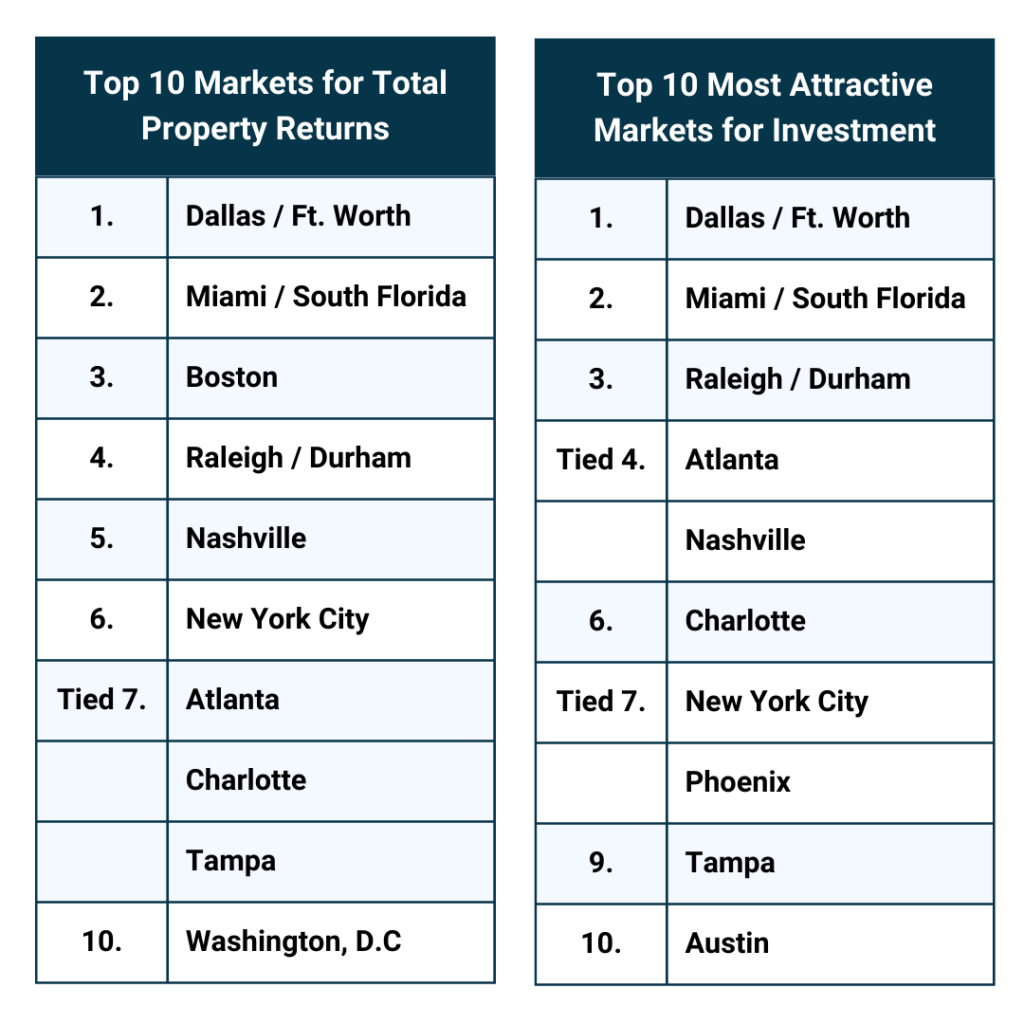
The large Sun Belt cities and some high-performing secondary markets continue to remain attractive locations for investors to consider such as Dallas, Miami, Raleigh and Nashville. Other top-performing markets include some large gateway cities such as Boston, New York City, and Washington D.C. Check out the full list of cities below.

Source: U.S. Investor Intentions Survey, CBRE Research, January 2024.


Varied Investor Strategies

Developers, private equity funds, real estate funds, and REITs are showcasing a higher percentage of plans to buy more assets in 2024 compared to other investors.


Plans to Sell Assets Increase

Even with a decline in property values, 40% of those surveyed show an intention to sell more properties in 2024 than in 2023.


Anticipation of Transaction Activity Recovery

Around half of the investors are hopeful for a revival in both their personal transaction activities and the broader market by the latter half of 2024, possibly sooner if the 10-year Treasury yield decreases more rapidly than forecasted.


Source: 2024 U.S. Investor Intentions Survey

In the ever-evolving landscape of real estate investment, landlords are finding cause for optimism as rising rents outpace home prices in numerous markets across the country. According to ATTOM’s Q1 2024 Single-Family Rental Market Report, this trend is driving up investment returns and presenting lucrative opportunities for real estate investors seeking strategic deals in today’s dynamic market conditions.

The report highlights a notable uptick in rental demand, fueled by a combination of factors including historically limited housing supply and a deceleration in home price appreciation. Between 2023 and 2024, median three-bedroom rents surpassed median single-family home prices in 63% of the markets analyzed, leading to incremental increases in rental yields.

Anticipated average annual gross rental yields for three-bedroom properties are projected to reach 7.55% in 2024, representing a slight uptick from the previous year’s figures. This marks the second consecutive year of rising projections following a period of declines, signaling a resurgence in rental market performance.

Noteworthy growth in rental returns is observed across most regions, with potential annual gross rental yields for three-bedroom properties increasing in 216 out of 341 counties analyzed. Leading this surge are markets such as Taylor County (Abilene), TX, Jefferson County (Birmingham), AL, and Richmond County (Augusta), GA, where yields have seen significant gains.

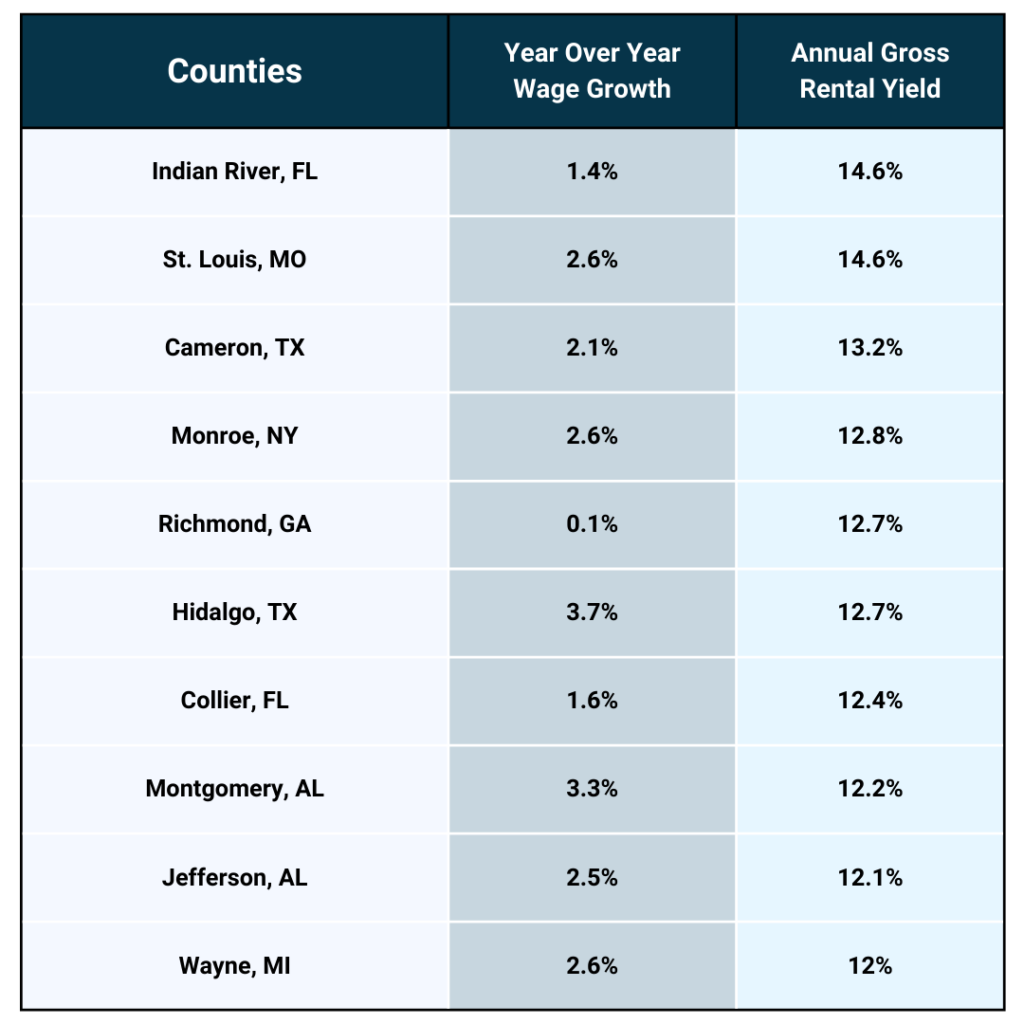
Furthermore, ATTOM’s report identifies the top 28 single-family rental growth markets, where average wages have risen, and potential rental yields surpass 10%. Notable inclusions on this list are Chicago, Detroit, and Cleveland, underscoring the breadth of opportunities available to investors across diverse markets.

Below are the top counties experiencing the highest rental growth: 

Source: ATTOM, Top 10 Counties for Buying Single Family Rentals in 2024

For real estate investors seeking strategic investment opportunities, ATTOM’s latest findings offer invaluable insights into the evolving dynamics of the single-family rental market. With rising rental yields and promising growth prospects, these trends provide a roadmap for navigating the current market landscape and unlocking lucrative investment opportunities.

ATTOM released their 2024 Rental Affordability Report outlining the top 10 counties with the highest rental rates. Explore the list below for pricing, affordability, market trends, and how these factors are affecting both renters and homebuyers interested in these areas. 


1. Collier County, Florida 

In 2024, Collier County, Florida has a premium 3-bedroom rental price of $8,000, reflecting a substantial commitment for renters with a rental affordability index of 153%. However, real estate investors should note that buying is more cost-effective than renting in this market, as home prices have been rising faster than rents, indicating potential opportunities for long-term appreciation. The Jan-Nov 2023 home sales prices at $770,000 provide historical context, aiding investors in evaluating the trajectory of property values for informed decision-making.


2. Santa Barbara County, California

Santa Barbara County, California, presents a 3-bedroom rental price of $6,950 in 2024, with an affordability index of 131%, emphasizing the relatively high cost of renting. Real estate investors should take note that, similar to Collier County, buying is more cost-effective in Santa Barbara County, as home prices are rising faster than rents. The report reveals the Jan-Nov 2023 home sales prices were $830,000. 


3. Marin County, California 

Marin County, California features a 3-bedroom rental price of $6,000 in 2024, offering relative affordability for renters. In contrast to the previous counties, Marin County stands out as a place where renting is a more viable option, as rents have been rising faster than home prices. The Jan-Nov 2023 home sales prices were reported at $1,644,625. 


4. Westchester County, New York 

Westchester County, New York, within the New York City metropolitan area, presents a 3-bedroom rental price of $5,500 in 2024, with moderate rental affordability at 76%. Real estate investors should note that renting is more favorable in this county, as rents are rising faster than home prices. The report states that Jan-Nov 2023 home sales prices were $809,000. 


5. Orange County, California

Orange County, California, famous for its coastal beauty, features a 3-bedroom rental price of $5,450 in 2024, providing relatively better affordability for renters. Real estate investors should take note that renting is favored in this county, as rents are rising faster than home prices. This sought-after coastal region showcased Jan-Nov 2023 home sales prices of $1,192,500. 


6. Los Angeles County, California

Los Angeles County, one of the most populous in the United States, presents a 3-bedroom rental price of $5,300 in 2024, offering relatively affordable options for renters compared to some other high-rent counties. Real estate investors should consider that renting is favored in this county, as rents are rising faster than home prices. The report revealed that the Jan-Nov 2023 home sales prices in this populous county were $880,000. 


7. Monterey County, California

Monterey County, renowned for its stunning coastline and natural beauty, features a 3-bedroom rental price of $5,145 in 2024 with a favorable rental affordability at 107%. Real estate investors should consider renting as a viable option in this county, given its relatively good affordability, especially as rents have been rising faster than home prices. In Jan-Nov 2023, home sales prices in this California county averaged $830,000.


8. San Mateo County, California

San Mateo County, situated in the tech-centric San Francisco Bay Area, features a 3-bedroom rental price of $5,000 in 2024. Although rental affordability is lower, real estate investors should recognize renting as a viable choice, given the faster-rising rents compared to home prices. The Jan-Nov 2023 home sales prices at $1,780,000 highlight the county’s high-end market and its notable presence in the tech industry. 


9. San Francisco County, California

San Francisco County, showcases 3-bedroom rentals priced at $4,990 in 2024. Despite a challenging rental affordability at 37%, real estate investors should consider renting as a favored option due to rents rising faster than home prices. The county’s job growing market makes it an appealing location for those interested in new career options, as reflected in the competitive housing market with a median home sales price of $1.5 million in early 2023.


10. Riverside County, California

Riverside County, California, features a 3-bedroom rental price of $4,800 in 2024 with a favorable rental affordability at 101%. Real estate investors should note that, despite its apparent affordability, buying is preferred in Riverside County due to faster-rising rents compared to home prices. The county’s accelerated wage growth further enhances its appeal, making it a compelling choice for potential homebuyers seeking investment opportunities in this dynamic California market. In Jan-Nov 2023, home sales prices averaged $586,000. 


Source: ATTOM: Top 10 Counties with the Highest Rental Rates in 2024. Read the full article here. 

As the real estate landscape undergoes continuous shifts, the recent findings from ATTOM’s Q3 2023 U.S. Home Flipping Report present a nuanced perspective for savvy investors. In this article, we delve into the key insights, exploring the dynamics of home flipping, profit margins, and the top-performing counties for fix and flip returns in Q3 2023. 

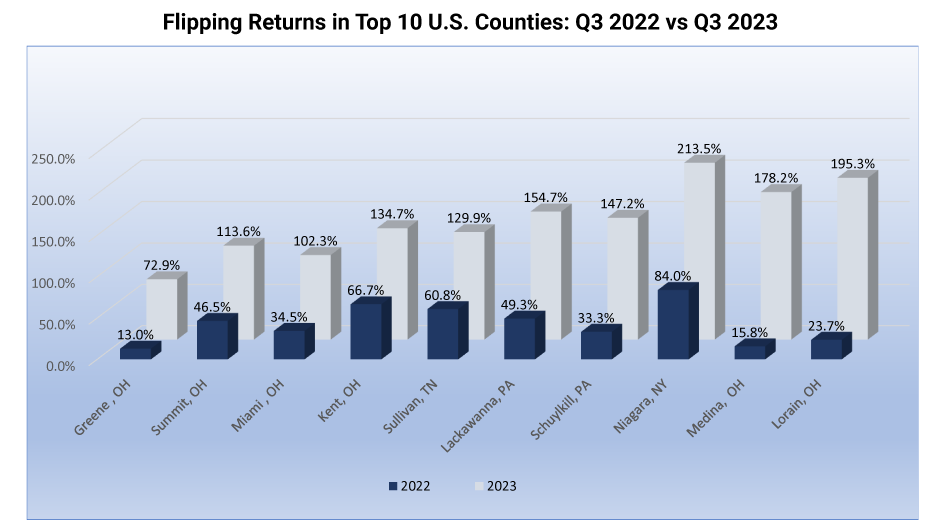
Top 10 Counties with Highest Annual Increases in Flips from Q3 2022 vs Q3 2023

The article unveils the top 10 U.S. counties with the highest annual increases in home flipping returns in Q3 2023. This information can be invaluable for investors looking to target specific counties with the greatest potential for profitable real estate ventures.

Source: ATTOM. Top 10 U.S. Counties with Highest Annual Increases in Home Flipping Returns in Q3 2023

National Flipping Trends

The Q3 2023 U.S. Home Flipping Report highlights that 72,543 single-family homes and condos were flipped, constituting 7.2 percent of nationwide home sales. Although this percentage is a decrease from the previous quarter and the same period last year, it showcases a significant presence of flipping activity in the market.

Profitability Resilience 

Despite a decline in flipping rates, the report emphasizes an encouraging trend for real estate investors — rising profits. Investor returns increased for the third consecutive quarter, rebounding from a prolonged slump that had severely impacted profit margins from early 2021 to late 2022.

Record-Breaking Margins

Q3 2023 witnessed profit margins and raw profits reaching their highest levels since the middle of the previous year. This suggests that even in the face of fluctuating market dynamics, investors have successfully navigated challenges, resulting in improved financial outcomes.

Profit Margin Metrics

The typical profit margin for Q3 2023 was 29.8 percent nationwide. While this remains below the peaks seen in 2021, it reflects a positive trajectory compared to Q2 2023, marking a seven-percentage-point increase from the low observed in Q4 2022.

Regional Variations 

The report underscores regional variations in profit margins, with some areas experiencing more substantial increases than others. Understanding these regional nuances is crucial for investors seeking to capitalize on the most lucrative opportunities in the diverse U.S. real estate market.

Metro Area Performance 

The report indicates that profit margins increased from Q2 to Q3 2023 in 51 percent of the metro areas analyzed and were up annually in 61 percent. This suggests that certain metropolitan areas are exhibiting consistent growth in profitability for real estate investors.

Standout Locations 

The report identifies specific locations that have seen remarkable year-over-year increases in profit margins. Notable examples include “Akron, OH (ROI up from 50 percent in Q3 2022 to 114.1 percent in Q3 2023), Flint, MI (up from 61.6 percent to 113.8 percent), Canton, OH (up from 17.8 percent to 69.6 percent), Augusta, GA (up from 44.8 percent to 93.5 percent), and York, PA (up from 61.5 percent to 107.5 percent).”

Investment Strategy Shifts 

The report’s findings suggest that investors should remain agile and adapt their strategies to capitalize on emerging trends. Understanding the ever-changing landscape is essential for making informed decisions and maximizing returns.

Population and Home Flip Volume Criteria 

The criteria of counties with a population greater than 100,000 and 25 or more home flips in the third quarter for inclusion in the top 10 list underscores the importance of considering both population density and transaction volume when assessing investment opportunities.

Source: ATTOM. Top 10 U.S. Counties with Highest Annual Increases in Home Flipping Returns in Q3 2023. Read the Full Article Here. 

In the fast-evolving landscape of real estate investment, the dynamism of the Single-Family Rental (SFR) market has captured the attention of seasoned professionals and institutional investors alike. Amid this fervent environment, the emergence of a groundbreaking partnership within the Private Client Group has redefined the narrative of portfolio financing solutions.

The Private Client Group, a consortium of seasoned real estate professionals, has set its sights on elevating the SFR capital markets through its commitment to deploy over $3 billion in capital for SFR portfolios. This ambitious endeavor has been made possible through a strategic alliance with one of the largest Global Asset Managers in the country.

A shining example of this collaboration comes from the sponsorship of one of the fastest-growing U.S. SFR investors, a global real estate private equity group boasting an impressive portfolio of over $23 billion in transactions. What sets this sponsor apart is not just its sheer magnitude but its trailblazing history in real estate investments.

Founded in 1994, this sponsor made its mark as one of the pioneering non-domestic real estate investors in Asia. Its investments tell the tale of visionary ventures—ranging from a sprawling 3.8-hectare shopping center development in Tokyo to spearheading one of the largest solar power plants in Japan. Their expansive footprint extends across various lucrative assets including hotels, offices, and retail properties nestled in the heartlands of China and Japan.

What truly underscores the depth and breadth of their influence is the global imprint they’ve etched, with over 100 employees dispersed across offices in the U.S., Europe, Japan, and China. Their multifaceted approach blends intricate deal structuring with a keen understanding of market dynamics, distinguishing them as formidable players in the realm of real estate investment.

This collaboration between the Private Client Group and this distinguished sponsor signifies a paradigm shift in the SFR market. It aligns the expertise of a seasoned team with the financial muscle of a global asset manager and the visionary prowess of a pioneering investor.

Their shared vision transcends mere financial transactions; it’s a testament to their commitment to revolutionize how SFR portfolios are conceptualized, structured, and propelled towards unprecedented success.

Central to this narrative is the sponsor’s trailblazing SFR investment platform, launched in 2020 to seize the untapped potential of the U.S.-based SFR market. Since its inception, this platform has been nothing short of revolutionary, exemplifying a commitment to innovation and foresight in investment strategies.

The platform’s accomplishments speak volumes, with investments surpassing 2,400 homes at a staggering total cost exceeding $600 million. These investments sprawl across nine states and encompass 17 Metropolitan Statistical Areas (MSAs), strategically positioning the sponsor at the heart of thriving real estate markets.

What distinguishes this SFR investment platform is its composition—a meticulous curation primarily consisting of newly built townhomes and duplexes nestled within meticulously planned Build-to-Rent (BTR) communities. This unique focus on curated portfolios underscores the sponsor’s commitment to innovation and foresight in investment strategies, shunning the conventional in favor of pioneering new avenues.

The sponsor’s acquisition strategy is as multifaceted as it is forward-thinking, encompassing both the purchase of completed homes and the groundbreaking approach of building from the ground-up. This multifaceted strategy not only diversifies their portfolio but also positions them as trailblazers in the realm of SFR investment.

The emphasis on newly built properties within planned BTR communities reflects an acute understanding of evolving market demands and a commitment to providing high-quality, in-demand housing solutions. This strategy not only speaks to their financial prowess but also to their dedication to fostering communities and meeting the evolving needs of the modern-day tenant.

The synergy between the Private Client Group and this forward-looking sponsor is not just a confluence of financial expertise but a testament to shared values of innovation, strategic foresight, and a steadfast commitment to reshaping the SFR landscape.

Together, they stand on the precipice of transformation, leveraging the sponsor’s visionary SFR investment platform and the Private Client Group’s seasoned acumen to carve a path towards unprecedented success.

In an industry characterized by evolution, this partnership serves as a beacon, heralding a new era of SFR investment—one defined by innovation, foresight, and an unwavering dedication to excellence. It’s not merely a collaboration; it’s a proclamation of intent—a promise to redefine the norms, set new standards, and shape the future of real estate investment.

In the world of real estate, equity is king. Every homeowner, at one time or another, has pondered ways to extract more value from their most cherished asset. With the glittering horizon of Philadelphia serving as a backdrop, one emerging trend is captivating those in-the-know: the strategic overhaul of a property’s outdoor space to fortify its market worth. Companies like Terren Landscapes, nestled in the lush suburbs of Philadelphia, are pioneering a nuanced approach, illustrating that the road to unlocking home equity might just be paved with well-appointed cobblestones.

The principle is simple yet ingenious. By investing in landscape design and installation, homeowners are not merely beautifying their domains, but they are directly augmenting their home’s intrinsic value.

1.  Return on Landscape Investments

A report by the National Association of Landscape Professionals suggests that homeowners can expect a return of over 100% on landscaping investments. To put that in perspective, consider the ROI on other popular home improvement endeavors—like remodeling a kitchen or bathroom, which can often garner a return of anywhere from 60% to 120%.

This promising prospect has prompted homeowners, particularly in affluent regions, to team up with high-caliber companies. The objective? To reimagine their outdoors into a realm where functionality fuses with artistry.

2.  Beyond the Aesthetic Appeal

But the pull of landscape installations isn’t limited to its aesthetic allure alone. Thoughtful landscaping offers tangible financial benefits in the guise of energy savings. Properly placed trees and shrubs can act as natural insulators, reducing heating and cooling costs. Moreover, a well-maintained landscape can bolster a property’s drainage system, mitigating risks associated with water damages—a solution that can sometimes lead to lower home insurance premiums.

3.  Drawing Potential Buyers

In the frenetic realm of real estate, first impressions can make or break a deal. A property enveloped in a cloak of vibrant blooms, cascading water features, and impeccably manicured lawns can intrigue potential buyers, even before they step through the front door. It’s a silent testimony to the homeowner’s commitment to quality and care.

This sentiment is echoed by Terren Landscapes, which has, over the years, sculpted some of the most breathtaking outdoor living spaces in the Philadelphia region. Their handiwork stands as a testament to how landscape installations can be a nexus of art and investment.

4.  The Financial Landscape

As homeowners set their sights on landscape redesign, many are leaning on real estate loans tailored for home improvements. These loans, often with competitive interest rates, serve as a financial conduit, allowing homeowners to realize their vision without draining their coffers.

Lenders, recognizing the potent ROI of landscape installations, are more amenable to underwriting such ventures. It’s a harmonious dance between homeowner ambition and financial pragmatism.

5.  A Sustainable Vision

Beyond the immediacy of monetary returns, there’s an intangible yet profound allure to landscape installations—the promise of sustainability. Companies, cognizant of the changing environmental narrative, are weaving in green practices. From rain gardens that prevent water runoff to native plants that demand less water and care, the focus is clear: curate a landscape that’s both exquisite and ecologically responsible.

As the sun sets over the skyline of Philadelphia, casting a golden hue on its sprawling suburbs, it’s evident that the city and its environs are on the cusp of a landscaping boom. A movement championed by visionaries like Terren Landscapes, reminding us that our homes’ true potential might just lie in the world outside our windows.

What is Build-to-Rent? 

Build-to-rent (BTR) is a real estate investment approach centered around the construction of purpose-built rental properties, such as apartment complexes or housing communities, with the primary intent of generating rental income. In contrast to traditional real estate development, which often involves selling individual units or homes, BTR focuses exclusively on creating rental units. This strategy is gaining in popularity due to the rising demand in the rental market from buyers turning towards renting due to affordability concerns. 

Build-to-Rent (BTR) Increasing Demand 

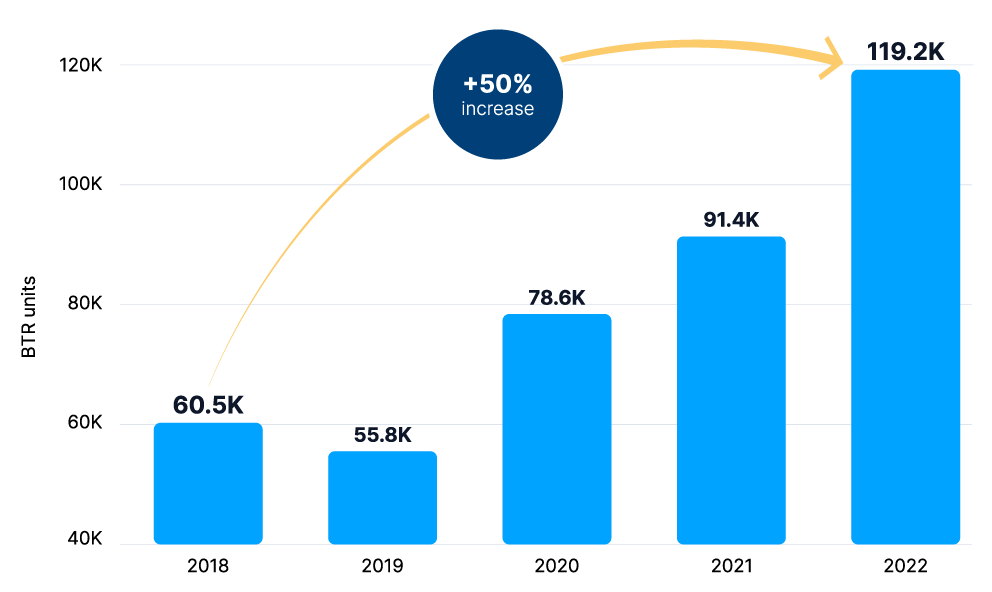
According to Fixr.com’s “Build-to-Rent Homes Report 2023” The National Association of Homebuilders estimated that “69,000 BTR homes began construction in 2022.” Fixr goes on to predict that this number is slightly higher due to the construction of homes sold to other parties specifically for rental purposes, totaling this estimate to actually be closer to 119,250.  The chart below showcases an over 50% increase in build to rent starts over the course of five years. 

Reported by Fixr.com based data from the Census and National Association of Homebuilders (NAHB).

Who is Driving this Build-to-Rent Demand?

According to the report, demand for BTR homes is split between Gen Z (55%) and Millennials (41%).  Tenants in these age demographics prefer the lifestyle opportunities that BTR properties can provide. Because purchasing a home may be unaffordable for many, the option and flexibility that comes from renting one of these BTR properties is much more attractive. There are no maintenance costs, no mortgages to pay, and the community amenities and benefits without the added price tag of home ownership. 

Where is Build-to-Rent Demand the Highest? 

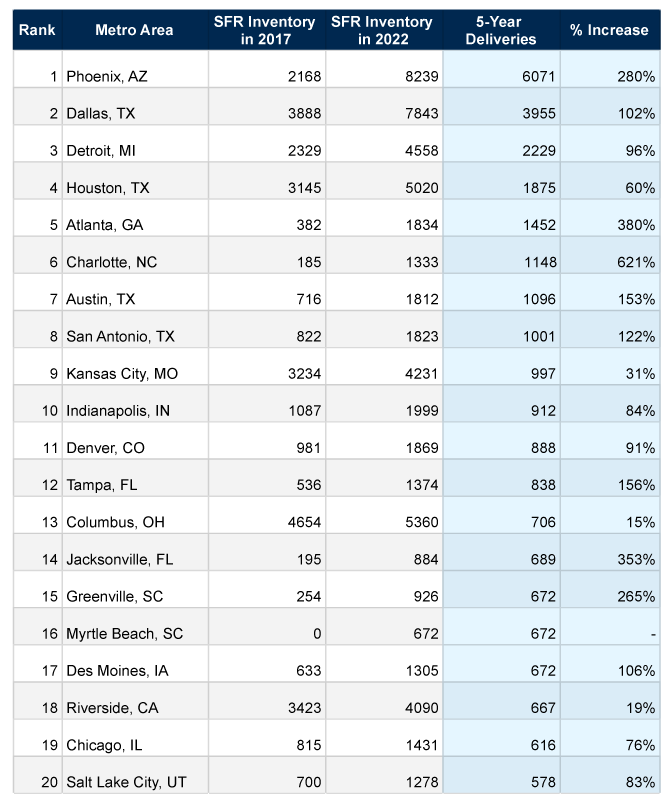
According to data provided by RentCafe, Phoenix, Arizona tops the list for the most tenants moving into 6071 rental properties in the last five years, increasing from 2168 units in 2017 to 8239 units in 2022. Charlotte, North Carolina however had the highest percentage growth for BTR units in five years at 621%. Below are the top 20 areas with the most BTR units, with Phoenix, Dallas, Detroit, Houston, and Atlanta making the top five. 

Top 20 Metros with the Highest BTR Units Built Over the Past 5 Years

Reported by Fixr.com based Yardi Matrix data.


The growing build-to-rent market offers real estate investors lucrative opportunities to capitalize on for their next investment property purchase. LendingOne’s Private Client Group offers investors in this market customized financing options such as a Bridge-to-Permanent Loan and a BTR CO Bridge Loan. Learn more here

Demand in the single-family rental market has been increasingly on the rise. As housing prices continue to climb and inventory is unable to keep up with the growing demand, potential buyers are shifting their focus more towards renting. 

John Burns Research & Consulting recently released their Single-Family Rental Survey reporting on the current metrics surrounding the SFR market. They surveyed over 234K owners of professionally managed SFR homes across 52 markets in the first half of August.  According to the report, the SFR market has stabilized in recent quarters from the cooling-off period the country experienced following the pandemic boom. They are seeing a national blended SFR rent growth holding steady at 6.5% from Q1 to Q2 of this year, and new lease growth has increased from 7% to 8% nationally from Q1 to Q2. Additionally, operating expenses have grown nationally, causing an offset in rent gains. 

We outline our top three takeaways from the report for real estate investors interested in the current state of the single-family rental market. 


1. Blended SFR Rents Are the Fastest Growing Asset Class 

The survey reports that national blended SFR rent growth (7% YOY) exceeds apartment rent growth (2% YOY) and new and resale home price appreciation (1%-2% YOY). Overall, blended SFR rents were reported to be growing faster than other asset classes like new home and apartment markets or the resale market. 

Sources: Reis Services, LLC; Census Bureau; Moody’s Analytics; Burns Home Value Index™ (BHVI); Atlanta Federal Reserve Board Wage Growth Tracker; Blended single-family rent growth as published in the Burns Single-Family Rental Market Index.


2. Average Rent Prices Nationally Reached $2,054 in Q2 

The report states that approximately half of respondents reported average rents of $1,750 – $2,250, resulting in a national average rent of $2,054 in Q2.  Northern California had the highest weighted average monthly rent at $2,900, with the Midwest averaging the lowest at $1,700. Northern Florida rents averaged $2,100, a higher average rent than the Southeast region’s $1,750. 

Source: John Burns Research and Consulting, LLC (Data: 2Q23, Pub: Aug-23)


3. Occupancy is at an All-Time High (97% Average) 

According to the survey, operators reported a 97% average occupancy rate nationally, with 13% of operators seeing 99%-100% occupancy across their portfolios.  Overall, occupancy rates were up significantly from Q2 (95%) to Q1 (72%). Northern California held the highest occupancy rate at 99% with Southern California, Southern Florida, and the Northwest following at 98%. 

Source: John Burns Research and Consulting, LLC (Data: 2Q23, Pub: Aug-23)


This growing single-family rental market offers real estate investors lucrative chances to scale their portfolios and increase revenue. LendingOne offers a variety of rental loan products that can provide the necessary financing options investors need. Click here to learn more.

For real estate investors seeking to turn distressed properties into lucrative opportunities, fix and flip loans are an essential tool. This specialized financing option is designed to support fix and flip investors’ strategy, allowing them to purchase rundown properties, renovate them, and sell for a profit. In this comprehensive guide, we will explore all aspects of fix and flip loans, their benefits, and how they empower investors to thrive in the competitive real estate market.

What Are Fix and Flip Loans?

Fix and flip loans, also known as rehab loans or hard money loans, are short-term financing options tailored specifically for real estate investors pursuing fix and flip projects. Unlike traditional mortgages that focus on long-term property ownership, these loans cater to the unique needs of investors seeking swift returns on their investment. Fix and flip loans are secured by the property being renovated, making the process efficient and accessible for experienced and novice investors alike.

The Benefits of Fix and Flip Loans

  1. Quick Access to Capital: Fix and flip loans offer quicker approval and funding, enabling investors to seize time-sensitive opportunities in the real estate market. With a simplified application process, investors can access the necessary capital to purchase distressed properties and begin renovations promptly.
  2. Short-Term Loans: These fix and flip loans typically span from six to twelve months, aligning with the quick turnaround strategy of fix and flip projects. Investors can execute renovations and sell the property within a relatively short timeframe, recouping their investment capital and profits fast.
  3. Minimal Credit Requirements: Fix and flip loans prioritize the property’s potential for profitability and the investor’s experience rather than relying heavily on credit scores. This leniency opens doors for more investors to leverage opportunities.
  4. Higher Loan-to-Value (LTV) Ratios: Fix and flip loans often boast higher LTV ratios compared to traditional mortgages. Lenders finance a substantial portion of the property’s purchase price and renovation costs, reducing the need for a significant upfront capital investment.
  5. Flexibility in Property Types: Fix and flip loans can be used to finance a wide range of property types, including single-family homes, multi-unit buildings, and commercial properties. This versatility empowers investors to explore various market segments.

Applying for a Fix and Flip Loan

  1. Research Lenders: Begin by researching reputable fix and flip lenders who specialize in short-term financing. Consider their interest rates, loan terms, and customer reviews to make an informed decision.
  2. Preparing Documentation: Gather the necessary documentation, such as property information, renovation plans, financial statements, and personal background, to support your loan application.
  3. Loan Application Process: Fill out the loan application form and submit all relevant documentation to the lender. A fix and flip loan typically involves a faster approval process compared to traditional mortgages.

Maximizing Success with Fix and Flip Loans

  1. Conduct Thorough Market Research: Before embarking on a fix and flip project, conduct comprehensive market research to identify profitable locations, emerging trends, and potential buyers.
  2. Create a Detailed Renovation Plan: Develop a detailed renovation plan and budget to ensure a smooth execution of the project. Stick to the plan to avoid cost overruns and delays.
  3. Build a Reliable Team: Assemble a team of experienced contractors, real estate agents, and other professionals who can contribute to the success of your fix and flip project.
  4. Time Management: Efficiently manage the timeline of your fix and flip project to meet deadlines and capitalize on market conditions.

Conclusion

Fix and flip loans are a game-changer for real estate investors seeking to capitalize on distressed properties and maximize their returns. With their quick approval process, short-term durations, and flexibility in property types, fix and flip loans empower investors to thrive in the dynamic real estate market. By conducting thorough research, preparing necessary documentation, and building a reliable team, investors can unlock the full potential of fix and flip loans and achieve success in their investment ventures.

Looking to invest in your next fix and flip property? Learn more about our fix and flip loans with competitive rates, low fees and high leverage options for real estate investors.