
During the Pandemic Housing Boom, surging housing demand, ultra-low mortgage rates, and rapid home price appreciation pulled a wave of home flippers into the market, as short hold times and rising values made quick resales highly profitable. Today’s environment looks different, but it has also become more selective. Borrowing costs are higher, and price growth has moderated across much of the country, placing a greater emphasis on disciplined underwriting and operational execution.

Number of home flips in the U.S. by quarter

Even so, market conditions remain favorable in a subset of metro areas—largely smaller Midwest and Northeast markets—where home prices are still rising, inventory remains constrained relative to pre-pandemic levels, and recent flip performance suggests that well-structured deals continue to pencil.

To identify the best markets for home flipping in 2026, LendingOne evaluated the following data for 180 metro area housing markets:

  • Year-over-year change in home prices between December 2024 and December 2025, according to the Zillow Home Value Index
  • Year-over-year change in active housing inventory for sale between December 2024 and December 2025, as measured by our analysis of Realtor.com data
  • Active housing inventory for sale at the end of December 2025 compared to December 2019, as measured by our analysis of Realtor.com data
  • The typical gross profit on home flips in Q3 2025, according to ATTOM Data
  • The typical gross return on investment (ROI) on home flips in Q3 2025, according to ATTOM Data

LendingOne’s methodology is rooted in a simple premise: markets where inventory remains meaningfully below pre-pandemic levels and home prices are still rising are more likely to support price stability and resale demand during a flip hold period. To validate this framework, we also examined recent flip profitability to ensure these markets are not just theoretically attractive but also practically viable.

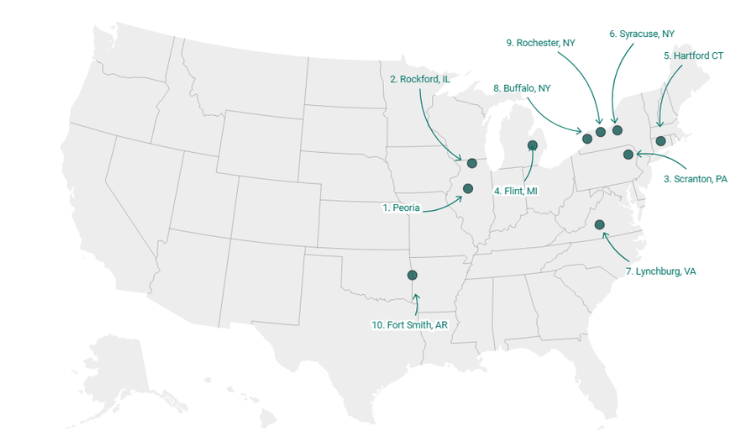
Let’s take a look at the top 10 markets for home flippers in 2026.

Top 10 best home flipping markets for 2026

#1 Peoria, IL

Typical home value in December 2025: $161,212

Year-over-year home price change: +8.6%
Typical flipping gross profit: $56,250
Gross ROI: 73.8%
Inventory compared to pre-pandemic 2019 levels: -14.7%

Peoria ranks at the top of the list thanks to a rare combination of strong price appreciation and high flipping returns. Home prices rose nearly 9% over the past year, while inventory remains below pre-pandemic levels, helping support resale pricing. For flippers, Peoria offers a classic Midwest value profile: low acquisition costs, an aging housing stock, and enough demand to sustain attractive exit spreads.

#2 Rockford, IL

Typical home value in December 2025: $205,334

Year-over-year home price change: +8.0%
Typical flipping gross profit: $62,500
Gross ROI: 54.3%
Inventory compared to pre-pandemic 2019 levels: -40.5%

Rockford combines fast home price growth with deeply constrained inventory. Active listings remain roughly 40% below 2019 levels, tightening competition for move-in-ready homes. That dynamic continues to translate into strong flipping margins, particularly for investors targeting affordable entry points outside the Chicago metro.

#3 Scranton–Wilkes-Barre, PA

Scranton-Wilkes-Barre-Pennsylvania-Real-Estate-Market

Typical home value in December 2025: $218,596

Year-over-year home price change: +3.4%
Typical flipping gross profit: $104,500
Gross ROI: 104.0%
Inventory compared to pre-pandemic 2019 levels: -46.0%

Scranton remains one of the strongest risk-adjusted flipping markets in the country. Inventory is nearly 46% below pre-pandemic levels, and typical gross profits now exceed $100,000. The metro’s highly affordable housing stock and large share of older homes continue to create fertile ground for value-add renovations.

#4 Flint, MI

Typical home value in December 2025: $183,404

Year-over-year home price change: +5.2%
Typical flipping gross profit: $63,304
Gross ROI: 72.3%
Inventory compared to pre-pandemic 2019 levels: -50.1%

Flint pairs solid price growth with severely constrained inventory. Active listings are roughly half of what they were in 2019, tightening supply for renovated homes. For flippers, Flint offers low basis, strong ROI, and consistent buyer demand for updated housing.

#5 Hartford, CT

Hartford-Connecticut-real-estate-market

Typical home value in December 2025: $376,811

Year-over-year home price change: +4.8%
Typical flipping gross profit: $131,950
Gross ROI: 55.4%
Inventory compared to pre-pandemic 2019 levels: -72.9%

Hartford stands out for the severity of its inventory shortage. Listings remain nearly 73% below pre-pandemic levels, among the tightest conditions nationally. Even with a relatively high typical home value of $376,811, that scarcity has helped support strong resale pricing and six-figure flip profits. For experienced, well-capitalized flippers, Hartford’s combination of constrained supply and steady price growth continues to create attractive opportunities.

#6 Syracuse, NY

Syracuse-New-York-real-estate-market

Typical home value in December 2025: $245,913

Year-over-year home price change: +4.4%
Typical flipping gross profit: $97,000
Gross ROI: 70.3%
Inventory compared to pre-pandemic 2019 levels: -49.4%

Syracuse continues to benefit from tight supply and steady demand. Inventory remains roughly 50% below pre-pandemic levels, creating pricing power for renovated homes. Combined with an aging housing stock, the metro remains a strong market for value-add strategies.

#7 Lynchburg, VA

Typical home value in December 2025: $274,091

Year-over-year home price change: +1.0%
Typical flipping gross profit: $158,500
Gross ROI: 130.5%
Inventory compared to pre-pandemic 2019 levels: -12.5%

Lynchburg stands out for outsized flip returns. Typical gross profits exceed $150,000 and ROI tops 130%, despite only modest price growth. These results suggest deals in Lynchburg are being driven primarily by basis and renovation execution rather than market appreciation.

#8 Buffalo, NY

Typical home value in December 2025: $270,322

Year-over-year home price change: +3.7%
Typical flipping gross profit: $122,300
Gross ROI: 94.1%
Inventory compared to pre-pandemic 2019 levels: +44.5%

Buffalo is an outlier on inventory, with active listings above pre-pandemic levels. Even so, recent flip data shows strong profitability, reflecting low acquisition costs and buyer demand for renovated homes.

#9 Rochester, NY

Rochester-New-York-real-estate-market

Typical home value in December 2025: $260,900

Year-over-year home price change: +2.8%
Typical flipping gross profit: $95,500
Gross ROI: 64.9%
Inventory compared to pre-pandemic 2019 levels: -60.1%

Rochester remains deeply undersupplied relative to 2019, helping support resale pricing even as price growth has moderated. The metro continues to offer a compelling combination of affordability, tight supply, and strong flip margins.

#10 Fort Smith, AR

Fort-Smith-Arkansas-real-estate-market

Typical home value in December 2025: $194,831

Year-over-year home price change: +3.6%
Typical flipping gross profit: $68,500
Gross ROI: 50.2%
Inventory compared to pre-pandemic 2019 levels: -60.2%

Fort Smith rounds out the top 10 with solid price growth and extremely tight inventory. Active listings remain about 60% below pre-pandemic levels. For flippers, Fort Smith offers low entry costs and consistent demand for renovated housing.

Big Picture

Home flipping in 2026 is increasingly a market-selection and execution-driven business. The strongest opportunities are clustering in smaller Midwest and Northeast metros where housing remains affordable, inventory is constrained, and recent flip data confirms that value-add strategies can still generate attractive returns.

Debt service coverage ratio (DSCR) loans are viewed by many investors as an excellent financial tool to build a portfolio of rental properties. Eligibility for a DSCR loan is based primarily on a property’s income-producing potential, rather than the personal income of the borrower.

This guide covers the best lenders offering DSCR loans, along with how you can determine the one best suited for you. LendingOne, in particular, tops the list due to its investor-focused model, offering flexible DSCR options and a nationwide footprint.

Regardless of where you are in your investment journey, getting paired with the right lender can make all the difference in helping you reach your goals.

Key Takeaways

  • DSCR loans allow investors to get financing based on the property’s income potential, rather than the borrower’s personal income.
  • Available loan terms, rates, and underwriting criteria can vary greatly among lenders.
  • Shopping multiple DSCR lenders is highly recommended to ensure you find a lending partner aligned with your investment strategy.

What Is a DSCR Loan?

A DSCR loan is a way to finance real estate by evaluating the property’s income potential. These loans work by considering the property’s net operating income and dividing it by its total debt service per year.

A ratio greater than 1.0 means the income should cover at least the debt payments. Not all loans are created equal, however, as terms and fees vary among lenders. In addition to a DSCR ratio of greater than 1.0, lenders may look for a loan-to-value (LTV) ratio of up to 80%.

Although, these requirements may vary by loan type, whether fixed, adjustable-rate mortgage (ARM), or interest-only. As one example, you can explore our DSCR rental loans to see what we offer to investors.

Top DSCR Lenders in 2025

Borrowers have many options when it comes to choosing a DSCR lender. The best one will depend on your rental strategy, experience level, and preferred loan terms.

LendingOne is a top choice because its programs are heavily geared towards investors, but other lenders in this guide also offer competitive programs.

1. LendingOne

LendingOne is a national direct lender specializing in financing solutions tailored for investors. It offers financing in every state except Alaska, Nevada, North Dakota, and South Dakota, with programs that can cater to new acquisitions as well as long-term rentals.

With a low DSCR ratio requirement of as low as 0.75, getting approved can be much simpler. Investors can also choose from fixed- and adjustable-rate financing options, with terms up to 30 years.

LendingOne stands out for its commitment to streamlining the process and offering financing flexibility. Borrowers routinely benefit from quick closings and guidance from the lending team. Whether you’re a new or seasoned investor, LendingOne can provide the financing you need quickly.

2. Renovo Financial

Renovo Financial offers DSCR loans primarily for stabilized rental properties, and financing is available nationwide.

For qualification and loan eligibility, the lender typically requires investors to have a track record of success in prior rentals. While Renovo Financial can work with newer investors, pricing and loan terms may not be as competitive.

Notably, the company utilizes relationship-driven underwriting. This can provide a greater chance of approval with more competitive terms for investors seeking repeat transactions with a single lender.

For this reason, it’s a great option for investors who want a long-term financing partner, rather than an option for one-time deals.

3. Dominion Financial

Dominion Financial is a private lender that can offer DSCR loans for investors who need to finance portfolios of single-family properties. Lending programs are available nationwide and are geared towards investors with long-term rentals.

This lender appeals to investors who value reliability and consistency when it comes to being able to obtain funds for a real estate investment opportunity.

However, it should be noted that its underwriting and eligibility criteria can be more strict than those of other lenders. This factor can result in slower funding speeds and less flexibility in financing terms.

4. Conventus

Conventus is a private lender based in California, making it an excellent option for those looking to invest in its local real estate market. With that said, the lender also lends in 44 other states, with a focus on DSCR financing for short-term rentals.

Investors will typically find that Conventus has a flexible approach to its underwriting standards. This can make it easier to qualify for investors or properties that have a less traditional income or cash flow profile.

For that reason, it’s an excellent option to consider for those seeking complex investments that may not otherwise meet more traditional lending requirements.

5. Constructive Capital

Constructive Capital is a private lender that offers investors DSCR loans, bridge funding, and other temporary and transitional financing programs. It can be an ideal fit for investors who need custom loan terms that otherwise aren’t offered by traditional DSCR lenders.

It also has flexibility in its eligibility criteria when it comes to financing properties where the property condition may not meet the requirements for other lending programs.

However, some investors may find that loan sizing and geographic availability can be more limited. Before you get started, you’ll want to be sure that Constructive Capital offers financing for your area.

6. RCN Capital

RCN Capital is a nationwide private lender that offers a wide range of financing for real estate investors. This includes short-term, long-term, construction, fix and flip, and DSCR programs.

It is widely known for its reliability and consistency when it comes to providing the necessary funding to allow investors to acquire, rehab, and exit investment projects.

RCN Capital often works with experienced investors who are already managing a portfolio of several properties. Investors may, however, find that the terms offered may be less flexible and more conservative.

7. Visio Lending

Visio Lending offers financing centered around DSCR programs. This makes it ideal for long-term rental investors, as well as those looking to grow an existing portfolio.

Visio Lending has relatively standard underwriting processes and requirements. The appeal for this is its ability to offer a consistent experience for repeat customers seeking a predictable and reliable experience across markets.

While the company can offer financing for short-term, transitional, or less traditional properties, investors may find that terms are not as competitive or flexible. As a result, most find the company’s solutions better suited for stabilized, cash-flowing real estate.

8. Logan Finance

With Logan Finance, investors can get DSCR loans through wholesale and broker channels. Its expertise and loan program popularity center around long-term retail financing.

Highly qualified investors will be eligible for flexible and competitive financing terms and will be able to experience a streamlined process from application to funding.

Investors should be aware, however, that since it offers financing through intermediaries, support and guidance may be limited. As a result, many find Logan Finance to be more suitable for straightforward, less complex transactions.

How to Compare the Best DSCR Lenders

To choose the best DSCR for your circumstances, consider things like underwriting criteria, flexibility, available loan programs, funding speeds, and pricing. For more on how to evaluate DSCR programs, head over to our overview of DSCR loans for real estate investors.

Speed and Efficiency

Quick access to funding can mean the difference between securing a property and losing out to another buyer. Here, the ability to close quickly can be critical, especially in markets where sellers are receiving multiple offers in a short period of time.

While it’s possible to close in around 10 days, a more realistic timeline is closer to 21 days or more, depending on the complexity of the transaction.

Investor-Focused Underwriting

Lenders that understand the nuances of rental real estate can increase the likelihood of getting approved, given their ability to consider less traditional underwriting criteria.

This commonly involves looking at the property’s ability to generate cash flow, as opposed to the borrower’s own credit and income. Investor-focused underwriting can also make it likely that loans get approved more quickly and without requiring as much paperwork.

DSCR and LTV Thresholds

Lenders each have varying requirements for DSCR and LTV. In most cases, a DSCR ratio between 1.0 and 1.25 will provide excellent odds of getting approved. The higher your DSCR is, the more favorable pricing you can get.

Similarly, lenders look for an LTV of up to 80%. The lower your LTV, the better, as lenders see your investment as less of a risk.

If you’re curious how well a property might perform, consider utilizing our DSCR loan calculator.

Loan Flexibility and Structure

The best DSCR lenders offer a variety of loan terms and structures to accommodate different investment strategies.

Longer repayment terms of up to 30 years can be suitable for properties held in the long term. Meanwhile, fixed, interest-only, or adjustable-rate programs can provide stability or increased property cash flow.

Fees and Transparency

In addition to rates, other costs are incurred as part of the lending process, many of which are passed on to the borrower. Common charges include origination, underwriting, appraisal, closing, and third-party inspections.

Stick with lenders that are transparent about these costs up front to avoid surprises later in the lending process.

Nationwide Coverage

Investors looking to expand or grow across state lines should make sure they partner with a lender that has a broad geographic reach. Lenders may not be able to lend in a state if they have not yet obtained the proper licensing.

Choosing a lender that can offer financing for your properties can eliminate the possibility of having to find another lender in the future.

Why LendingOne Leads the Market

LendingOne stands apart from the many excellent DSCR lenders because of its ability to support investors looking to scale their rental portfolios. It also offers flexible underwriting processes, a wide range of loan terms and structures, and fast funding speeds.

Those looking to take the next steps in growing their portfolios can connect with a LendingOne loan advisor to discuss their goals.

Tailored for Growth Investors

LendingOne’s programs are geared toward those who regularly acquire and manage rental properties. It’s particularly ideal for those implementing a buy, rehab, rent, refinance, and repeat (BRRRR) or managing between 5 and 20 pieces of real estate.

LendingOne’s underwriting approach supports this investment model due to a focus on an individual property’s ability to generate positive cash flow, rather than a borrower’s personal income or tax returns.

Fast, Transparent Closings

LendingOne utilizes a defined five-step process to ensure borrowers move through the financing process quickly and smoothly. The end result is the ability to go from prequalification to funding in an average of 14 to 21 days.

Fast closings are also aided by the fact that its underwriting teams are well-versed in real estate investment loans. This makes conditions and requirements straightforward and simple.

Flexible Loan Options

LendingOne offers a wide range of loan options to meet the needs of nearly any type of investor. For example, investors who want to hold real estate long-term can select the company’s 30-year programs.

Fixed, interest-only, and adjustable-rate options are also available, depending on whether you want stability in payments or the ability to boost cash flow in the immediate term.

Nationwide Partner Network

With the ability to lend in 46 states, LendingOne can provide the same consistent lending experience for investors looking to expand into new markets.

This eliminates the need to acclimate to a new lender’s processes, something that could otherwise slow down the rate at which you can continue to finance properties.

See where we lend for a full list of where financing is available.

Choosing the Best DSCR Lender for Your Portfolio

Choosing the best DSCR ultimately comes down to your goals. Some investors place a high value on the ability to close deals quickly, while others may focus more on the ability to secure financing at the best pricing.

If you’re uncertain, LendingOne is an excellent starting point given its balanced combination of speed, flexibility, and expertise. You can connect with a LendingOne advisor today to see which DSCR solution is right for you.

Frequently Asked Questions

What minimum DSCR is required to qualify?

Most lenders require a DSCR  between 1.0 and 1.25 to be eligible for financing. The higher the ratio, the more easily the property’s income can cover the underlying debt payment. While some lenders allow lower ratios, those loans often carry higher rates and fees.

Can I use a DSCR loan for short-term rentals?

Yes. DSCR loans can be used to finance both short- and long-term rental properties. Lenders will typically evaluate market rents or projected rents in calculating a DSCR ratio. Eligibility criteria, however, may be different, and availability can also vary by lender.

Do I need personal income verification?

In most cases, no personal income verification is needed. This is because DSCR loans prioritize the income-producing ability of the property in determining ability to repay debt. More traditional methods often involve looking at a borrower’s personal income.

What are typical interest rates and fees?

Interest rates fluctuate throughout the year. However, current rates typically fall between 6% and 8%.

Note that this can vary by lender, the loan program you choose, as well as the strength of your application. This can include things like your DSCR ratio, down payment amount, and credit profile.

Common fees include origination, underwriting, appraisal, and other third-party inspection fees.

How quickly can DSCR loans close?

On average, DSCR loans can be closed within 21 to 30 days. The specific timing can vary based on things like the lender’s total volume of loan applications, the complexity of your application, and the availability of third-party companies like appraisers.

Selecting the best fix-and-flip lenders is key to ensuring you can close quickly and obtain the necessary amount of capital for a project. Ultimately, it determines how reliably you can continue to grow and scale.

Financing involves more than just interest rates. It can have a direct impact on your ability to secure a deal ahead of competitors. It can also determine the speed at which a rehab can be completed and affect overall margins.

The best lender will be different for each investor and will be determined by how well it fits your unique strategy. This guide breaks down the top criteria to be considered in selecting the right financing for fix-and-flip projects.

Key Takeaways

  • The best fix-and-flip lenders can execute to align with an investor’s priorities, whether it be speed, reliability, leverage, or underwriting flexibility.
  • Along with pricing, closing timelines, funding processes, and eligibility criteria are some of many factors that define the best fix-and-flip lenders.
  • The best lender will vary for different investors, as each has lending solutions catered for various scenarios.

Criteria Used to Define the Best Fix-and-Flip Lenders

Comparing the best fix-and-flip lenders should begin with factors that impact the ability to execute on business strategies. This can be broken down into the following six major areas:

  • Speed to Close: Closing quickly can impact whether an investor can secure a deal and whether closing timelines can be met, budgets maintained, and margins maximized. Closing should occur within one to two weeks.
  • Leverage and Capital Coverage: Loan-to-cost (LTC) and after repair value (ARV) limits dictate how much an investor must contribute from their own funds. Greater leverage typically translates to better portfolio growth and capital efficiency.
  • Rehab Draw Process: Consistent and quick draws for additional funds are key to ensuring projects are kept on schedule. Here, virtual inspections can also save time in comparison to in-person inspection requirements.
  • Underwriting Approach: The best lenders have flexible approval criteria to maximize approval odds. This can include property-based underwriting, as well as a wide range of experience and income requirements.
  • Transparency and Communication: Keeping unexpected surprises to a minimum, if not nonexistent, can be done with clear terms, fees, and consistent communication.
  • Exit Flexibility: Whether an investor wants to sell or refinance a property, the specific prepayment terms and exit options can have a significant impact on return on investment (ROI).

The Best Fix-and-Flip Lenders

Below is a comparison table of the best fix-and-flip lenders that met the criteria mentioned above. These companies are commonly considered by investors and differ in funding speeds, terms, exit options, and more.

1. LendingOne

LendingOne is a nationwide lender that focuses on providing financing solutions to residential fix-and-flip investors through its fix-and-flip loan program.

Loans are underwritten based on property fundamentals such as their potential to generate income, rather than assessing an investor’s individual income.

In many cases, investors can secure financing up to a 92.50% loan-to-cost and 75% ARV. Closing can also occur in 10-14 business days, depending on deal complexity.

Funds for rehab projects can be released through a draw process that allows for virtual inspections at each stage. While LendingOne usually works with experienced investors, eligibility criteria can vary based on each individual deal.

LendingOne charges no prepayment penalties to allow for exit flexibility. This is often evaluated by investors seeking quick financing speeds and the ability to apply a consistent financing structure across multiple projects.

2. Renovo Financial

Renovo Financial is a private lender offering financing in select markets across the U.S. Notably, this company offers competitive LTC and ARV terms and eligibility criteria on both purchases and rehab projects.

While exact timelines can vary by market and deal complexity, most closings are completed efficiently. Like some other lenders, rehab draws are available on a continuous basis following completed work and satisfactory inspections.

With regards to underwriting criteria, Renovo Financial is typically geared towards investors who have a track record of experience in managing fix-and-flip projects. The company evaluates both historical success as an investor, as well as the fundamentals of the property being acquired.

Ultimately, Renovo Financial is often evaluated by experienced flippers that are in markets where this company offers financing.

3. Anchor Loans

Anchor Loans is an established private lender offering residential fix-and-flip and bridge financing nationwide.

The company offers competitive terms and eligibility criteria that offer flexibility for both new and seasoned investors. Although, the company’s best terms may only be available to those with a track record of success.

Investors who choose to work with Anchor Loans can also expect quick closings and standard exit options with refinancing or selling properties. This may be relevant for investors wanting to work with a lender that has a nationwide footprint.

4. Easy Street Capital

As a private lender, Easy Street Capital offers short-term residential loans to investors in a handful of states. Purchase and rehab financing are available, with rehab funds being released on a standard schedule based on completed work and subsequent inspections.

While there can be flexibility in eligibility criteria, available terms may not be determined until after application. This is because it can be dependent on the deal structure, investor profile, and property characteristics.

In general, Easy Street Capital’s underwriting focuses on a mix of property fundamentals as well as investor experience. It is often considered by investors seeking straightforward fix-and-flip financing on standard deals.

5. Conventus

Although it does not offer financing nationwide, Conventus is a private lender focusing most of its activity in coastal and urban markets.

The company offers purchase and rehab financing with terms that can vary based on the details of the deal. This can include investor experience, property characteristics, and market conditions. These items can also impact closing timelines.

As a general rule of thumb, Conventus works primarily with seasoned investors. Notably, repeat borrowers may benefit from its relationship-based underwriting methodologies, which may be relevant for investors seeking a long-term lending partner.

6. Archwest

Archwest is a private lender that offers bridge and fix-and-flip financing for residential investors nationwide. Underwriting and eligibility criteria are flexible, as the company caters to both new and seasoned investors alike.

However, note that the timeliness of closing can be impacted by the complexity of deals. Newer investors likely need to provide additional documentation to ensure eligibility, something that can cause slightly longer closing timelines.

With that said, Archwest offers a wide range of financing for purchases and rehabs alike. It evaluates both property fundamentals as well as borrower-specific items such as track record and income.

This company may be sought after by investors seeking nationwide availability and a more traditional lending process.

How to Choose the Best Fix-and-Flip Lender for Your Strategy

To select the best fix-and-flip lender for your circumstance, prioritize the criteria that will have the largest impact on what matters to you the most.

For example, new investors may benefit from lenders that offer consistent and reliable draws, along with clear or more traditional processes and loan terms. Experienced investors, on the other hand, may prefer speed and leverage.

Similarly, investors working on multiple deals simultaneously may prioritize fast closings. These can offer a more efficient use of capital and the ability to scale a fix-and-flip investment without tying up cash.

Remember to also consider the balance between speed and leverage. Being able to close quickly can help you secure more deals, but long-term growth is fueled by efficient use of capital. You may also want to consider the best markets for fix-and-flip investment.

Finally, consider your exit strategy, whether it’s to sell or refinance. It can impact the best options for things like prepayment terms and long-term flexibility.

Why Real Estate Investors Choose LendingOne Fix-and-Flip Loans

The best fix-and-flip lenders can help drive outcomes in the form of consistency and reliability for closings, clear expectations and timelines for rehab funding, and repeatable terms that investors can use across multiple deals.

With these in mind, LendingOne is often evaluated by investors who value speed, capital efficiency, and reliable execution time and time again.

To see how LendingOne’s financing solutions can align with your next deal, see your rate and review terms unique to your specific flip.

FAQs About Choosing the Best Fix-and-Flip Lender

How Much Experience Do I Need to Qualify?

Required experience varies from lender to lender. It can also depend on the overall strength and complexity of your application. Certain lenders may be able to work with first-time flippers on smaller projects, while others prefer investors with completed renovations.

Underwriting criteria can also consider an investor’s track record along with property characteristics in determining eligibility, pricing, and approval timelines.

How Quickly Can I Close on a Fix-and-Flip Loan?

It’s possible to close within one to two weeks. However, exact timelines will vary depending on the complexity of the deal, the lender’s own internal processes, and the strength of your application. In general, private lenders are also a bit faster than marketplace lenders.

How Do Rehab Draws Work?

Rehab funds are released in stages after completed work is verified by inspections. If the inspections are satisfactory, funds can then be released, so the next stage of work can be conducted.

Are Rates or Leverage More Important?

Both are important and depend on your specific business strategy. Lower rates reduce carrying costs, while higher leverage can aid the efficient use of capital.

Investors managing multiple projects simultaneously often prioritize leverage, while single-project investors typically care more about minimizing costs.

Can I Refinance Instead of Selling?

While refinancing as an exit strategy can be done, most fix-and-flip lenders expect the primary exit strategy to be a property sale. Be sure to discuss this upfront to avoid any unexpected surprises, as you may need to secure separate financing from another lender.

Do Fix-and-Flip Lenders Require Income Verification?

Most fix-and-flip lenders evaluate the property characteristics rather than the personal income of the investor.

While personal income can be a compensating factor, most deals will be evaluated by the property value, income-generating ability, renovation plans, and the investor’s track record.

The housing market heading into 2026 still looks nothing like the boom-and-bust whiplash of the last few years. Sales activity remains muted, and while mortgage rates have returned to the headlines following announcements from President Trump, rates are still elevated as of January 2026—keeping affordability strained and demand constrained.

In January, the latest data points to a market that’s cooling, but uneven by region. Inventory remains higher than a year ago in many parts of the country, and a growing number of supply-heavy markets are seeing home prices soften. At the same time, construction and insurance costs remain key swing factors that investors need to underwrite carefully, as they can materially shape both pricing power and cash flow.

Every month, investors are hit with a flood of new housing market data to consider. Each data point helps paint a picture of the current state of the U.S. housing market, but there are a few signals that are essential for savvy real estate investors to pay attention to.

To cut through the noise and help you stay up to date on what’s happening in today’s housing market, here’s LendingOne’s January 2026 market recap.

Price drops: The investor buyer’s market is expanding in supply-heavy metros

While national home price growth has flattened, there is still a distinct dispersion across metros.

Among the 200 largest metros, 79 markets saw home prices fall year-over-year between December 2024 and December 2025. Many of these are pandemic-era boom markets that expanded supply the most and are now being forced to re-anchor price levels to local incomes as demand resets at today’s payment levels.

The five metros with the largest year-over-year price declines include:

  • Cape Coral-Fort Myers, FL: -9.7%
  • North Port-Sarasota-Bradenton, FL: -8.2%
  • Naples-Marco Island, FL: -6.5%
  • Austin-Round Rock-Georgetown, TX: -6.0%
  • Tampa-St. Petersburg-Clearwater, FL: -5.2%

Housing markets where prices are dropping


Investor takeaway: The best buying windows tend to open when price declines coincide with rising inventory—but investors should stress test local fundamentals, including employment, supply pipeline, insurance costs, taxes, and demographics to separate temporary softness from longer-term risk.


Insurance: High carrying costs are quietly reshaping affordability

Housing affordability isn’t just about prices and mortgage rates anymore — carrying costs like homeowners insurance are becoming a larger part of the equation, especially in higher-risk regions.

The latest county-level data from economists at the National Bureau of Economic Research shows median annual home insurance premiums in 2024 ranged from under $1,000 to more than $8,000. The highest costs are concentrated in Florida, parts of the Gulf Coast, and additional high-cost pockets in other weather damage-prone markets.


Median annual home insurance premiums by county


Investors should be careful, as even if home prices are softening in Florida, that “discount” can get partially—or fully—eaten up by the rising carry cost burden—especially insurance.

Florida counties represent four of the five markets with the highest median annual insurance premium costs:

  • Monroe, FL: $9,400
  • Orleans, LA: $7,513
  • Broward, FL: $6,865
  • Miami-Dade, FL: $6,375
  • Palm Beach, FL: $6,326

So even if an investor is buying a home at a markdown, the annual premium difference vs. a “normal” market can be thousands of dollars—which directly hits cash flow and affordability for end buyers.

Investor takeaway: Florida price cuts can create opportunity (especially for well-capitalized buyers), but in many coastal and storm-exposed counties, insurance can overwhelm the value of the discount, making the true “all-in” affordability equation worse even as prices fall.

New permits: Builders stay cautious on single-family starts

Construction remains one of the key swing factors for housing supply — and January finally brought an updated read on how the last quarter of 2025 fared for new builds after the shutdown-related delays.

Single-family residential permits in October 2024: 971,000

Single-family residential permits in October 2025: 878,000

Multifamily (5 or more units) residential permits in October 2024: 394,000Multifamily (5 or more units) residential permits in October 2025: 478,000


U.S. housing permits

The newly released data shows that single-family building permits fell -9.6% year-over-year from October 2024 to October 2025, while multifamily 5 or more unit permits grew +21.3% year-over-year from October 2024 to October 2025. 

This highlights a housing supply pipeline that remains split: single-family construction is easing, while multifamily continues to contribute new inventory.

Mortgage rates remain elevated, and some builders are still leaning on incentives to keep buyer traffic moving. That’s helping manage absorption—but it also highlights how carefully operators are protecting margins in today’s affordability-constrained market.

Investor takeaway: Falling single-family permits can support longer-term scarcity — but near-term conditions still depend heavily on active inventory and pricing behavior in each market. For investors, the key is understanding which metros are still “supply-heavy” vs. which are structurally constrained.

Inventory: Supply getting closer to “normal”—especially in the Sun Belt

Inventory remains the market’s pressure valve—and the clearest signal of how much leverage buyers and sellers have.

The latest read shows inventory continuing to rebuild across many Sun Belt and Mountain West markets, while a number of Northeast and Midwest metros remain meaningfully below pre-pandemic levels. 

In other words: supply is coming back, but it’s coming back unevenly—with some markets now sitting well above their pre-pandemic baseline (the places that were hottest in 2021–2022), and others still operating with inventory levels far below 2019 levels.


Active housing inventory for sale compared to pre-pandemic levels

The five metro markets with the highest Dec. 2025 inventory vs. pre-pandemic Dec. 2019:

  • Memphis, TN-MS-AR: +54.9%
  • Austin-Round Rock-San Marcos, TX: +53.8%
  • Phoenix-Mesa-Chandler, AZ: +46.6%
  • Tucson, AZ: +44.5% 
  • Orlando-Kissimmee-Sanford, FL: +44.3%

The five metro markets with the lowest Dec. 2025 inventory vs. pre-pandemic Dec. 2019:

  • Hartford–West Hartford–East Hartford, CT: −72.9%
  • Chicago–Naperville–Elgin, IL-IN: −55.9%
  • Providence–Warwick, RI-MA: −51.3%
  • New York–Newark–Jersey City, NY-NJ: −43.8%
  • Cleveland, OH: −40.0%

Buyer demand has reset to what buyers can actually afford at today’s monthly payments, more resale owners are listing as the “must-move” pool grows, and builders are siphoning off marginal buyers with rate buydowns and incentives. 

Inventory seems to be rebuilding fastest in the markets where affordability stretched the most—and where the Pandemic Housing boom pushed demand the highest.

Investor takeaway: Markets where inventory is above pre-pandemic levels tend to be where pricing power is weakening fastest — which can create better acquisition entry points—especially when paired with resilient rent fundamentals.

Forecasts: A little national home price growth is expected in 2026

Forward-looking expectations are increasingly important in a market where price appreciation is no longer guaranteed.

Zillow’s latest metro-level forecast projects that national U.S. home prices will rise +2.1% between December 2025 and December 2026, but the metro-level outlook spans a wide range—from expected declines in some markets to stronger projected growth in others. Most forecasters expect U.S. home prices to rise +1% to +3% in 2026.

12-month forecast for metro-level home price change between December 2025 and December 2026, according to Zillow

The five metro markets (among the largest 200) with the highest projected home price change between Dec. 2025 and Dec. 2026:

  • Rockford, IL: +6.2%
  • Green Bay, WI: +5.3%
  • Knoxville, TN: +5.2%
  •  Appleton, WI: +5.0%
  •  New Haven, CT: +4.9%

The five metro markets (among the largest 200) with the lowest projected home price change between Dec. 2025 and Dec. 2026: 

  • New Orleans, LA: -3.8%
  • Lafayette, LA: -2.2%
  • Austin, TX: -2.0%
  • Shreveport, LA: -2.0%
  • Denver, CO: -1.0%

Investor takeaway: Forecasts aren’t destiny—but they’re useful signals for spotting where pricing momentum is expected to stay weak vs. stabilize. Use this as a screening tool, then underwrite conservatively based on local inventory, affordability, and rent growth.

Big picture

January’s housing data reinforces the story of a market that is cooling—but not collapsing. Inventory remains higher than a year ago in much of the country, with some supply-heavy regions now above pre-pandemic levels. That’s translating into even more price weakening in select metros, even as other regions remain supply-constrained and comparatively stable.

The macro backdrop remains defined by affordability—and in 2026, policy and carrying costs (like insurance) are becoming a bigger part of the affordability conversation. Investors should stay selective, prioritize underwriting discipline, and focus on markets where rising inventory and softer pricing improve entry points while rental fundamentals remain stable.

The housing and real estate investment landscape continues to adjust after several years of extraordinary volatility. What we’re seeing today is not a return to the ultra-liquid, ultra-competitive conditions of 2021–2022, but rather a more balanced environment. One where discipline, local knowledge, and patience matter again.

From mortgage spreads and borrowing costs to inventory dynamics and regional divergence, the market is quietly recalibrating and getting more favorable for investors. For investors willing to lean into fundamentals rather than headlines, this period is beginning to offer real opportunity.

Below are 5 key themes to watch for this spring.

1. Inventory Is Creeping Higher—and Time Is Back on the Investor’s Side

Another notable shift is on the supply side. While new listings aren’t surging dramatically, days on market are rising—which is increasing months of supply—and that alone is enough to change market psychology.

Homes that sit longer tend to attract more flexible sellers. Renovation-heavy properties, estate sales, and homes that missed the 2021–2022 pricing window are increasingly available at discounts relative to peak expectations in Sun Belt markets.

For investors, this matters. Longer days on market often mean: 1. Greater willingness to negotiate, 2. Preference for certainty and speed over top-of-market pricing, and 3. Increased openness to cash or investor-friendly terms.

We’re not seeing distress in a broad sense. We are seeing seller fatigue, and fatigue creates opportunity.

This dynamic is particularly beneficial for local operators who know their submarkets well. Inventory expansion doesn’t automatically translate to deals; it rewards investors who understand pricing, renovation risk, and exit timing.

2. Build-to-Rent Remains a Core Strategy—But the Cycle Is Shifting

On the build-to-rent (BTR) side, activity remains steady, especially when investors partner directly with homebuilders. At LendingOne, we continue to finance both:

  • Entire communities sold in bulk
  • Partial take-downs within for-sale developments

That model is now firmly established.

What is changing is the delivery pipeline. Many purpose-built BTR projects that began during the 2021 capital surge have now been delivered. New standalone BTR starts have slowed meaningfully, which should help rent growth normalize market conditions for projects delivering in 2026 and 2027.

We’re increasingly seeing BTR supply come from homebuilder pipelines rather than ground-up, investor-led developments. That’s an important distinction. Builders use BTR as a liquidity outlet, especially during periods of slower retail absorption. In turn, investors gain access to new products without taking full development risk.

Looking ahead, as construction costs stabilize, we expect interest in new BTR development to gradually swing up.

3. Where Investors Are Finding Deals Today

Despite the growth of marketplaces and national platforms, the most consistent deal sourcing remains local.

For small and mid-sized investors in particular, local relationships still win. Brokers, wholesalers, builders, and direct-to-seller channels continue to outperform broad listing platforms when inventory is rising, and homes are sitting longer.

What’s different today is that builders themselves are increasingly part of the sourcing equation. Some are actively engaging investor buyers to help manage standing inventory, especially in slower-moving submarkets.

The common thread across all strategies is market knowledge. Investors who understand their local buy boxes best are best positioned to capitalize on this phase of the cycle.

4. Regional Divergence Is Growing—And Fundamentals Matter More Than Ever

One of the clearest takeaways from the past year is that not all growth markets are created equal.

Markets driven primarily by retirees, second-home demand, or speculative inflows have proven far more volatile. Without strong employment growth, price appreciation alone is not a durable investment thesis. This is especially true when insurance, HOA fees, and carrying costs are rising.

Looking ahead, softer markets with higher inventory levels and strong long-term employment and population outlooks are likely to attract increased investor interest.

This is why certain corrected growth markets, such as Austin, are starting to look interesting again. While supply is abundant, long-term employment drivers remain intact. That doesn’t guarantee quick appreciation, but it does support long-term demand.

On the other end of the spectrum, supply-constrained regions in the Northeast and parts of California present a different opportunity set. Aging housing stock, limited new construction, and continued demand for modern layouts are driving interest in infill and spec redevelopment.

Local builders who can acquire small parcels and deliver updated product—four-bedroom homes, townhomes, or modest clusters—are increasingly well-positioned, particularly as national builders pull back in select markets.

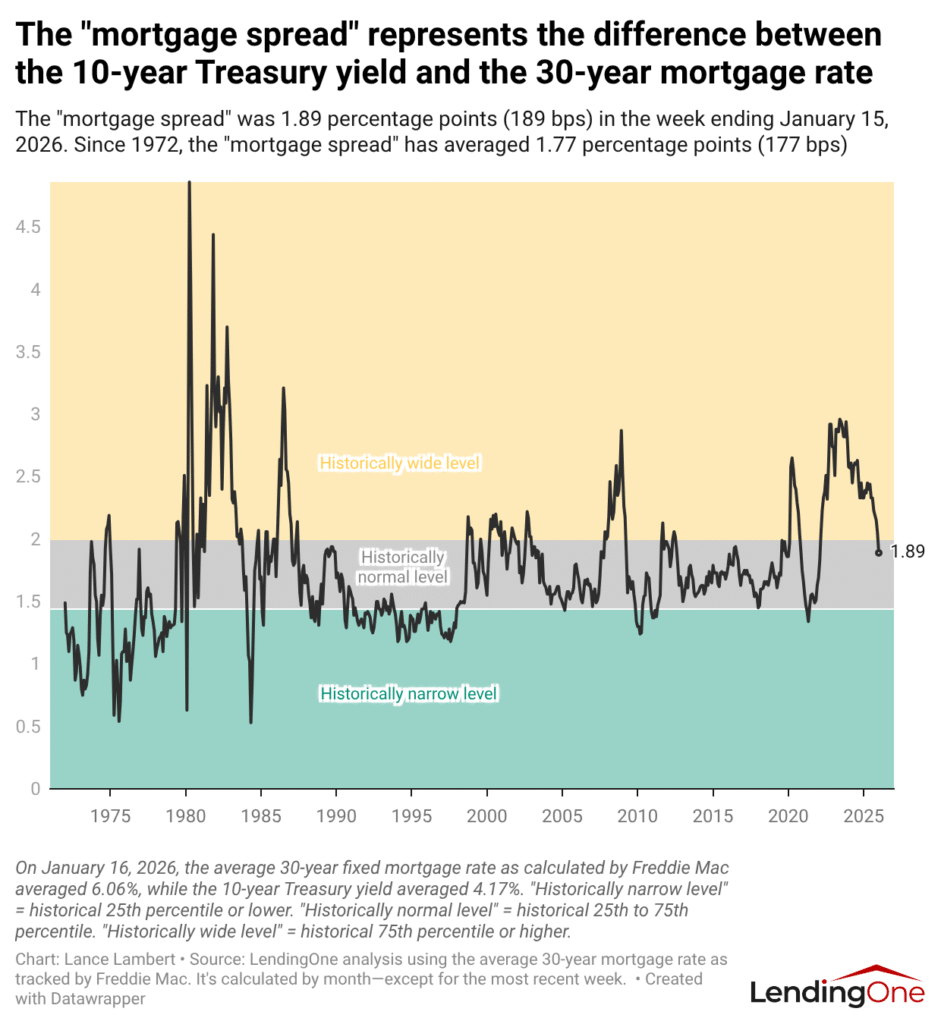
5. Mortgage Spreads Are Tightening—And That Matters More Than Many Realize

One of the more constructive developments we’ve seen recently is the tightening of mortgage spreads, driven in part by Fannie Mae and Freddie Mac retaining more mortgage bonds. While the mechanics of the mortgage-backed securities (MBS) market can feel abstract, the implications matter for rates.

When interest rates rise quickly, spreads naturally widen. Investors in mortgage bonds expect faster prepayments when rates eventually fall, so they demand more yield upfront to compensate for that risk. That’s a part of the reason that the average 30-year fixed mortgage rate in 2022 rose faster than the 10-year treasury yield. By spring 2023, the spread between the 30-year fixed mortgage rate and 10-year treasury yield was 300 bps—far above the 177 bps average spread since 1972.

What’s different now is that incremental demand for MBS—particularly from the government-sponsored enterprises (GSEs)—and lower prepayment risk (as rates have dropped from their highs) has helped compress those spreads. This doesn’t mean rates collapse overnight, but it does improve affordability on the margin and lowers borrowing costs relative to where they would otherwise be.  Indeed, as of Friday, the spread is closer to 190 bps.

That’s important for two reasons. First, it supports transaction velocity on the consumer side of the market. Second, for investors, it creates a more stable financing backdrop after several years of rapid rate shocks, Fed balance-sheet runoff, and reduced bank participation in mortgage lending.

The net effect is not a return to cheap money, but a move toward more functional, predictable borrowing costs.

Closing Thoughts

We’re no longer in a market where rising prices cover underwriting mistakes. That’s a good thing.

Today’s environment rewards:

  • Local expertise
  • Patience on entry and exit timing
  • A clear understanding of demand drivers

Mortgage spreads are improving, inventory is building gradually, and capital is becoming more selective. For disciplined investors, this combination is beginning to create a healthier opportunity set than we’ve seen in several years.

At LendingOne, we remain focused on supporting investors who approach this market thoughtfully through single-family rentals, build-to-rent partnerships, or localized redevelopment strategies.

The recalibration is still underway. But for those positioned correctly, the next phase of the cycle is starting to take shape.

An investment property loan is a form of real estate financing designed to help investors purchase, renovate, build, or refinance properties for investment purposes. Common investment purposes include fix and flip projects and long-term rental holds. 

However, when addressing which is the best loan for an investment property, it’s important to consider the asset, investment strategy, risk tolerance, and timeline. But with so many options, what type of loan is best for an investment property?

It depends. The right investment property loan type should match the deal, how quickly you need to close, and how you plan to scale.

This article will explain the differences among loan types, including fix and flip, debt service coverage ratio (DSCR) rental, new construction, and conventional mortgages.

Key Takeaways

  • There is no single “best” loan among investment property loans. The right financing will always depend on the specific property type, investment strategy, timeline, and exit plan.
  • Short-term loans, such as fix and flip and fix to rent, prioritize speed and leverage, while long-term options, like DSCR rental loans, support cash flow and portfolio growth.
  • Compared to conventional, FHA/VA, HELOC, or hard money options, LendingOne’s business-purpose loans offer higher leverage, faster closings, and underwriting based on the deal rather than personal income.

H2: What Are Investment Property Loans?

Investment property loans allow real estate investors to finance the purchase, construction, renovation, or repair of an investment property. Investment loans are designed for homes intended for investment purposes, such as fix and flip or long-term holds for rental income.

H3: How Investment Property Loans Work

Investment property loans and primary residence loans have a few key differences. First, investment property loans often carry higher interest rates to reflect the greater risk of default. They also tend to have stricter qualification requirements for credit scores and down payment amounts.

Finally, depending on the loan program, lenders may place greater emphasis on the property’s financial potential rather than the investor’s personal income.

Types of Properties That Qualify

Many different types of properties qualify for an investment property loan. This includes single-family rentals, multifamily properties, fix and flip projects, and new construction investments.

Depending on an investor’s track record and qualifications, some lenders may also offer portfolio loans for multiple properties.

Why Investors Use Specialized Financing

Real estate investors often have specialized needs that conventional loans often cannot meet. Depending on the loan program and lender, investment loans can offer faster approvals as well as more flexible qualification criteria and repayment terms.

These features can allow investors to acquire deals in a competitive market and finance properties at a faster rate than conventional financing might otherwise allow.

Comparing the Best Loans for Real Estate Investors

The “best” loan will differ depending on your needs and investment strategy, making it important to compare the details of each financing structure.

Loan TypeBest ForLeverage (LTC/LTV)What It FinancesKey Benefits
Fix and FlipShort-term rehab projectsUp to ~90% LTCPurchase, renovationFast closings, rehab funding included
Fix to RentRehabs converting to rentalsUp to ~85-90% LTCPurchase, rehab, refinancingSingle loan from rehab to rental
DSCR RentalIncome-producing rentalsUp to ~75-80% LTVStabilized rental propertiesNo personal income verification
New ConstructionGround-up buildsUp to ~85-90% LTCLand costs, construction costsDraw-based funding, flexible terms
Conventional MortgagePrimary or secondary homesUp to ~80% LTVPurchase, refinancingLow rates, long amortization
FHA or VA (Owner Occupied)Owner-occupied buyersUp to ~96.5% (FHA), 100% (VA)Primary residenceLow down payment options
HELOCEquity access on owned propertyBased on equityRevolving line of creditFlexible capital access
Commercial Multifamily5+ unit properties~65-75% LTVMultifamily acquisitionsScale assets
Hard MoneyTime-sensitive dealsUp to ~70% ARVPurchase, rehab Speed, minimal documentation

Fix and Flip Loan

A fix and flip loan is designed for investors acquiring properties to renovate and resell. These loans typically cover both purchase and renovation costs and are usually underwritten based on the deal, rather than personal income verification.

Because fix and flip strategies depend on speed, these loans are structured to support faster closings than traditional bank financing. They allow investors to turn capital efficiently and are best suited for experienced operators managing tight renovation timelines and budgets. Investors should, however, note that these loans are meant to be a form of short-term financing typically repaid within one to two years.

If you’re considering lending options, see our guide to the best fix and flip lenders.

Fix to Rent Loan

The fix to rent loan is a good fit for investors using the BRRRR method (buy, rehab, rent, refinance, and repeat).

BRRRR is used by investors building rental portfolios by purchasing undervalued properties, renovating them, and refinancing them into long-term rental financing. Fix to rent loans are structured to support this full transition from acquisition and rehab to stabilized rental.

At LendingOne, fix to rent loans can cover up to 95% of financing costs, with discounted refinance fees and a streamlined path into a DSCR rental loan.

DSCR Rental Loan

DSCR loans are well suited for investors pursuing long-term rental strategies. Instead of relying on personal income verification, qualification for DSCR loans is based on a property’s projected rental income.

In addition to flexible underwriting, DSCR loans typically offer 30-year terms. This allows investors to stabilize cash flow and execute long-term hold strategies.

New Construction Loan

New construction loans support investors developing build-to-rent homes or multifamily properties from the ground up. These loans provide capital for construction on vacant land and are often underwritten using projected rental income rather than personal income.

LendingOne new construction loans can offer up to 90% LTC and typically charge interest only on drawn funds. Flexible construction terms help accommodate longer build timelines and potential delays.

Conventional Investment Property Mortgage

Some multiproperty investors may qualify for traditional agency-backed investment loans, but the process is typically lengthy and documentation-heavy. Given the alternatives, these conventional loans are typically best for borrowers with high personal income and longer closing timelines. 

Conventional loans typically carry long repayment terms of up to 30 years. However, approval often requires tax returns, personal income verification, and strict debt-to-income limits. These limits commonly follow the 28/36 rule, which limits housing expenses to 28% of gross income and total monthly debt to 36% of gross income.

For investors seeking more flexibility, LendingOne offers business-purpose loans under an LLC that eliminate personal income verification and better align with active investment strategies.

LendingOne presents an alternative to conventional property loans and does not offer this traditional loan type. 

See our guide to DSCR loans vs conventional loans to see how these financing options compare. 

FHA and VA Loans

Certain investors may qualify for Federal Housing Administration (FHA) or Veterans Affairs (VA) loans. These are government-backed programs for owner-occupied properties. FHA loans allow lower down payments and more flexible credit requirements than conventional mortgages.

VA loans are available to eligible veterans and active-duty service members and offer 100% financing with no private mortgage insurance. Both loan types can be used to live in one unit while renting out additional units.

HELOC on Primary Residences

A home equity line of credit (HELOC) is a revolving line of credit that uses a home’s equity as collateral. This means investors can use the value of their home as a way to access capital to invest in another property type.

Commercial Multifamily Loan (5+ Units)

Commercial multifamily loans are used to finance apartment buildings with five or more units. These are typically underwritten using commercial lending standards, including factors like property performance, sponsor experience, and market fundamentals. 

Hard Money Loan

A hard money loan is a short-term financing option often used for time-sensitive real estate transactions. While these loans can provide fast access to capital along with flexible underwriting criteria, they typically come with higher interest rates and more restrictive terms. Hard money loans also tend to be less ideal for long-term holds due to the short repayment terms. 

LendingOne offers an alternative to hard money through structured private lending with consistent underwriting, transparent terms, and financing designed to support repeatable investment strategies.

Investors considering this option can review our guide to the best hard money lenders

How to Choose the Best Loan for Your Investment Property

If you’re not sure which of the above best serves your investment goals, ask yourself the following questions:

  • Timeline: When do you plan to invest? Are you targeting a near-term acquisition or a longer-term opportunity?
  • Property Condition: Is the property move-in ready, or does it require renovations? If so, how extensive is the scope of work?
  • Investment Horizon: Do you plan to hold the property long term, or exit after a shorter stabilization period?
  • Financing Preference: Do you prefer financing based on property cash flow or total project cost?
  • Purchase Type: Are you acquiring vacant land for new construction, or an existing structure?

The answers to these questions will help you determine which is the best loan for your investment property goals.

Investment Property Loan Requirements

Investment property loan requirements vary by lender and loan program, but the following are among the most common factors considered:

  • Credit Score: Higher scores represent a lower likelihood of becoming delinquent on a loan. Higher credit scores can also help borrowers qualify for more favorable terms. 
  • Down Payment: A large down payment of 25% or more reduces the lender’s risk in the event of a default, as it increases their likelihood of recouping losses during the foreclosure process. 
  • Cash Reserves: Cash reserves of six or more months of mortgage payments can signal lower risk of defaulting in the event of a temporary disruption to a borrower’s income. 
  • Property Cash Flow: Some programs, like DSCR loans, evaluate whether the property’s rental income can cover the corresponding mortgage payments. 
  • Investor Experience: Investors with a track record of successful investments are more likely to get approved and may qualify for more favorable loan terms.

Why Investors Choose LendingOne

LendingOne’s financing programs are built for real estate investors. Its programs are tailored for a variety of investment strategies, including BRRRR projects, fix and flip investments, new construction, and long-term rental investments. Eligible programs have flexible underwriting criteria to simplify the approval process. With a nationwide lending footprint and fast closings, LendingOne can support financing for long-term portfolio growth.

See your rate today or connect with a LendingOne advisor to find financing solutions tailored to your next property.

FAQs About the Different Types of Loans for Investment Property

Which Loan Offers the Highest Leverage?

LendingOne offers competitive leverage across its loan programs:

  • Fix to rent loan offers up to 95% of the cost of a purchase plus rehab.
  • Fix and flip offers up to 92.5% loan to cost (LTC) and covers up to 100% of rehab.
  • New construction loans can cover up to 90% of LTC.
  • DSCR rental loans offer up to 80% loan to value (LTV) for purchases.

These higher leverage rates can help investors reduce their upfront capital requirements and scale portfolios more quickly by preserving cash for additional projects. Leverage approval will always depend on project details and underwriting.

What If I Plan to Keep Some Properties and Flip Others?

Many investors use fix and flip for sale projects and fix to rent (or DSCR loans) for hold projects. This is straightforward, as LendingOne’s process stays consistent across both paths, reducing friction and speeding up execution.

For example, if an investor chooses fix to rent, they will already have documents on file to help them streamline their DSCR refinancing. It is not uncommon for investors to shift exit plans mid-project. LendingOne’s flexibility supports this.

How Quickly Can I Close?

Fix and flip and fix to rent loans from LendingOne can close in as little as 10 to 14 business days, depending on appraisal and underwriting readiness.

DSCR and portfolio loans can take longer, generally closing in around 21 business days. The timing of new construction loans depends on overall complexity, but tends to be streamlined once plans and budgets are provided.

In all cases, quick closings start with complete documentation, fast appraisal access, and upfront project clarity.

What Documents Do I Need?

To apply and qualify for a LendingOne loan, applicants need to show a current schedule of all investment properties. They will also be required to show personal identification such as a driver’s license.

For acquisitions, LendingOne will ask for proof of a purchase agreement. Construction or rehab projects may need to show their budget.

In all cases, borrowers should be prepared to provide title agent contact information and submit appraisal payment as part of the underwriting process.

Direct lending is often positioned as a flexible, advantageous way for real estate investors to borrow money without facing financing delays and underwriting friction. But, what is direct lending exactly?

In this article, we’ll explain what direct lending is, how it works, and why many real estate investors find this loan type to be more flexible, reliable, and practical than other traditional options.

We will also compare direct loan options with mortgage brokers and banks, going over the ways that these different types of loans have very different impacts.

Key Takeaways

  • Direct lending loans offer access to capital without an intermediary, with the same team underwriting, funding, and servicing each loan.
  • This results in faster approvals and speed to close (often within 10-21 days), clearer communication, and more direct accountability.
  • Many real estate investors find direct lending loans to be more in line with strategies like debt service coverage ratio (DSCR) and buy, rehab, rent, refinance, repeat (BRRRR) because they are more flexible and not based on personal income statements.

What Is Direct Lending?

Unlike brokered lending, where the borrower does not deal directly with the capital source, the direct lending model involves the underwriting, funding, and servicing of a loan in-house.

Direct lending eliminates the need for an intermediary. The result is faster approvals, more consistent communication, and loan structures that feel more investor-friendly.

These advantages make direct lending the preferred approach for many real estate investment loans, including fix and flip, new construction, debt service coverage ratio (DSCR) rentals, fix to rent, and portfolio financing.

How Direct Lender Loans Work

Real estate direct lender loans avoid any intermediary. Instead, they offer capital that is funded, underwritten, and serviced by the same company.

This creates a more predictable streamlined workflow that goes from application to closing.

The process typically starts with a quick prequalification assessment based on property details, investment strategy, and borrower experience. This contrasts with the process of traditional lending, which is usually determined by personal income verification.

When all decisions happen in-house, direct lenders can issue same-day quotes and begin underwriting immediately. This process is typically more reliable, efficient, and faster than the one offered by brokers or banks. It allows investors to effectively fund project milestones.

Direct lender loans also offer a flexibility that is especially tailored to investor needs, including higher leverage options and interest-only structures.

At LendingOne specifically, appraisals often run in parallel with underwriting. This means the documentation burden is minimal, and borrowers can close in as little as 10-21 business days, depending on loan type.

Direct Lender vs. Other Options

Direct loan lending is one of the options that real estate investors have at their disposal, but it’s not the only option. A closer, side-by-side look at the different types of loans makes the unique flexibility of direct lending even more obvious.

Direct LenderMortgage BrokerBank
Who Provides the CapitalFunds loans in-houseMatches borrowers with outside lendersFunds loans but with strict requirements
Speed to CloseFastest (often 10-21 business days, depending on product)Slower due to third-party involvementSlowest due to underwriting layers and documentation
Underwriting ApproachAsset-based and investor-focusedDependent on partner lendersHighly conservative and income-based
Documentation RequiredStreamlined, limited personal income verificationVaries by lender partnersExtensive (tax returns, W-2s, personal financials)
Communication FlowSingle team from quote to closeBroker communicates between borrower and lenderMultiple departments, slower updates
FlexibilityHigh flexibility in terms, leverage, and property typesVaries by lender; less controlLimited flexibility, strict guidelines
Best Fit ForInvestors needing speed, leverage, and reliabilityBorrowers rate shopping for consumer loan optionsInvestors prioritizing lowest rates and able to meet heavy requirements
Alignment With Investor StrategiesStrong: works well for fix and flip, DSCR, BRRRR, new constructionModerate: depends on lender relationshipsWeak: often not designed for value add or time-sensitive deals

Direct Lender vs. Mortgage Broker vs. Banks

Mortgage Broker:

  • Intermediary: Mortgage brokers discover and relay loan information but don’t offer the loan itself.
  • Competitive Rates: Since mortgage brokers shop a loan to multiple lenders, they can sometimes find the best rates and terms.
  • Time-Consuming: The comparison process takes time, which can be inconvenient for real estate investors who often work under a crunch.
  • Less Control: Since they’re not the lender, brokers have less control over underwriting and communication.
  • Risk of Misalignment: Investors might find a higher risk of miscommunication and a lack of accountability.

Overall, a mortgage broker makes the most sense for the borrower who wants to shop for rates for consumer-focused mortgages.

Banks:

  • Lower Rates: Because they are more selective in their lending practices and take fewer risks, banks are often able to offer lower rates compared to other lenders.
  • Heavy Documentation: In order to be approved, borrowers have to often go through a heavy documentation process that includes verification of personal income.
  • Time-Consuming: Documentation verification can take a while, which makes bank loan approval time much longer than other lenders.
  • Inflexible Underwriting: Bank underwriting is often not structured for many value-add projects that real estate investors gravitate towards, including buy, rehab, rent, refinance, repeat (BRRRR) strategies or fast-moving acquisitions.

Ultimately, banks are best suited for long-term projects where speed and leverage are not major concerns. This will likely only be the top choice for investors with ample liquidity and patience, who are more concerned with prioritizing the lowest rate over operational efficiency.

Direct Lender:

  • No “Middle Man”: Direct lenders fund the loans themselves using their own balance sheet, which includes sources like institutional partners, private credit funds, and recycled capital.
  • Full Control: Direct lenders enjoy full control over the entire lending process, including underwriting, pricing, and appraisals.
  • Predictable: Due to this control, direct lenders often make decisions faster, and their decisions are often more consistent and predictable.
  • Short Timeline: Many real estate investors choose to work with direct lenders when they’re working on a time-sensitive opportunity or repeat investments.

For borrowers looking to fund investment properties and favor speed, flexibility, and certainty, direct lending loans are likely the choice.

Benefits of Direct Lending for Real Estate Investors

One of the biggest benefits for investors is the speed of direct lending loans. Direct lending loans can close in as few as 10 business days and often close before the 21 business day mark.

The flexible underwriting process that centers around assets, not personal income, can also be enticing to investors who are newly scaling a rental portfolio.

One of the major ways real estate investing differs from a consumer real estate purchase is that investors more frequently rehabilitate or build new properties.

Direct lending loans come with a more flexible underwriting process that accounts for rehab and construction projects. As a matter of fact, direct lenders are often able to offer specialized investor products that are otherwise unavailable from traditional lenders.

As these details can get complicated, direct lending relies on transparent communication and a single point of accountability throughout the entire process. 

Challenges and Considerations of Direct Lending

Direct lending is not without its challenges. The most obvious downside is that direct lenders may have higher rates than what a traditional bank would give. Many investors see this as the cost of speed, flexibility, and investor-focused underwriting.

Additionally, many of the products offered via direct lending are more catered towards the needs of investors. This might be alienating to some borrowers, especially those seeking traditional consumer-style mortgages.

Even if a loan is well-suited, its leverage and terms can vary greatly based on asset type, borrower experience, and overall market conditions.

It’s important that borrowers compare their options carefully and choose a direct lender who’s well-reviewed and reputable.

When to Choose a Direct Lender

For many real estate investors, a direct lender is often a good option. But, there might be some circumstances that make the choice more obvious than others. This includes competitive markets where waiting on funding could mean losing out on a lucrative deal.

In some cases, investors may be required to give clear explanations of how and when they plan to fund a project. In other cases, a direct lending loan can provide this documentation.

Also, some loan types, like BRRRR require seamless transitions from short-term to long-term, which direct lending loans can provide. 

Builders who operate on tight construction timelines and need predictable draw schedules will also see the full benefits of a direct lender loan, as will investors who are looking to scale multiple properties. 

Why Investors Work With LendingOne for Direct Lender Loans

Investors across 46 states choose LendingOne as their direct lender for execution certainty and flexibility. LendingOne only focuses on real estate investors, which means we can offer fast, predictable underwriting decisions.

Our business-purpose loans are underwritten to the asset, not personal income. This helps investors move more efficiently without lengthy documentation.

LendingOne offers high-leverage funding options across rental, rehab, and construction programs to support investor portfolio growth.

Investors who work with LendingOne enjoy streamlined closings, consistent communication, and reliable draw management that reduces friction throughout the life of a loan. Get your rate today.

FAQs About Direct Lending

1. Do Direct Lenders Require Personal Income Verification or Tax Returns?

Many direct lenders qualify loans based on the asset rather than the borrower’s personal income. LendingOne does not require W-2s or tax returns for investor loans, including fix and flip, new construction, DSCR, fix to rent, and portfolio financing.

2. Are Direct Lender Loans More Expensive Than Bank Loans?

Direct lenders may have higher rates than banks because they prioritize speed and flexible underwriting. The tradeoff for investors is certainty and fast closings.

LendingOne consistently closes in 10-21 business days, depending on the loan type, which is significantly faster than traditional banks.

3. Can Direct Lenders Finance Properties Held in an LLC?

Most direct lenders support LLC borrowing for asset protection and streamlined portfolio management. All LendingOne loans are business-purpose loans that can be closed under an investor’s LLC. This makes it easier to separate personal and investment finances.

4. Are Direct Lenders Regulated the Same Way Banks Are?

No. Direct lenders are non-bank lenders and operate under different licensing frameworks, allowing faster credit decisions and more flexible investor requirements. LendingOne is licensed or exempt in 46 states and focuses solely on non-owner-occupied real estate loans.

5. Can I Use a Direct Lender for Long-Term Rental Financing?

Some direct lenders only provide short-term capital, but others offer both. LendingOne provides 30-year DSCR loans, portfolio loans, and fix-to-rent structures that transition from rehab to long-term financing under one lender.

6. What Types of Properties Do Direct Lenders Typically Finance?

It varies by lender, but many focus on non-owner-occupied residential real estate. LendingOne finances single-family rentals (SFRs), condos, townhomes, and 2- to 4-unit properties across fix and flip, DSCR, new construction, fix to rent, and portfolio loan programs.

Bridge loans are short-term financing options that fill the gap between closing the deal and gaining permanent financing. While they typically have higher interest rates and require collateral, they enable borrowers to take advantage of housing opportunities.

For example, a real estate broker waiting to close a sale on one property may identify a fix-and-flip opportunity. This broker can use a bridge loan to buy the new property to cover costs until the other sells.

This scenario highlights one of the common reasons why real estate investors may require a bridge loan. Traditional loans, in contrast, operate on slow approvals, inflexible terms, unreliable draws, and unclear pricing. All of these variables contribute to slower timelines.

The right bridge loan terms, however, can save money and fuel long-term growth.

Decoding Bridge Loan Financing For Investors

Real estate bridge loans aren’t standardized solutions. They differ depending on the lender and the lender’s understanding of the borrower. For example, while many bridge loans last six months, that’s hardly the maximum time. Some bridge loans extend up to three years. Thus, the idea of a short-term loan is rather flexible.

These loans are also unique. Unlike other financing options, bridge loans encompass a wider array of properties. Traditional loans often reject poorly maintained properties or ones without occupancy. Bridge lenders don’t factor in these variables, making bridge loans perfect for Fix & Flip, Fix to Rent (BRRRR), or even New Construction properties.

In addition, there are three different ways to use these short-term real estate loans. You can secure the bridge loan with the following:

  1. a new property being purchased,
  2. an existing home, or
  3. the current property, using it for the downpayment, and the new property, using it for the remaining balance.

Typically, interest rates for these loans are higher than traditional loans. Due to the short-time frame and the fact that payment is contingent on a closed property deal, lenders deem the risk higher. This is true whether you are looking at Fix & Flip bridge loans or New Construction bridge loans, and everything in between.

Who Should Use Real Estate Bridge Loans?

Bridge loans aren’t specific to real estate investors. A bridge lender offers similar services to homebuyers. However, bridge loans for investors provide support for several different project types, including:

  • Fix & Flip investors
  • Fix to Rent (BRRRR) investors
  • New Construction builders
  • Investors repositioning properties before long-term DSCR financing

Rather than focusing on whether you are the right market for this service, it is often more beneficial to look at bridge loan rates and terms and compare them to your other options.

Finding and acquiring a bridge loan is simple. Finding the right lender, however, may require some legwork.

Why Choosing the Right Bridge Lender Matters

Your bridge lender sets the terms and interest rate for the loan. Borrowing from a general financing solution or a bank is often cumbersome, and the lenders lack the expertise to understand the potential value and risk related to real estate investing.

Lenders can impact the speed to close, which in turn affects your project timelines, the cost of capital (interest rate), and long-term scalability of your investment strategy. The wrong lender with restrictive bridge loan terms can delay projects, depress revenue, and create funding constraints down the road.

For example, you are selling one property to afford a new rental. A poorly structured Fix to Rent bridge loan might limit renewals or have a slow draw speed, resulting in cash flow bottlenecks.

​Yet, Fix & Flips, (BRRRR, and New Construction projects can all benefit from bridge loan options. For success, it’s important to have a quality lender. They won’t just fund one project, but hopefully many more.

Common Mistakes Investors Make When Choosing a Bridge Lender

As with any financing tool, there are risks when choosing a bridge lender. Here are some common mistakes to avoid when evaluating your options:

  • Chasing the lowest rate only – Low interest rates can be appealing, but when combined with long approval periods or hidden conditions, they can cost you more down the road.
  • Ignoring draw speed and support – Slow disbursement speed affects your timeline directly. Poor customer support, in the case of draw issues, can create further setbacks.
  • Not reviewing extension policies – There may be cases when you need a loan extension. Failing to account for this can leave you short—with a bridge loan to pay back.
  • Choosing lenders without scalable programs – Some lenders grow with you, creating solid long-term relationships and the confidence to borrow when required.

Bridge Lender Financing Red Flags

Knowing red flags provides another layer of protection and allows you to remove lenders from your list early on. Here are some easy-to-spot red flags when it comes to bridge loan lenders.

  • They don’t perform a credit check.
  • The process feels rushed.
  • The interest rate is suspiciously low.
  • The lender claims there is a limited time to make a decision.
  • Advertised rates and terms act as a bait-and-switch.
  • Terms include prepayment penalties, late payment fees, and other hidden fees.
  • Terms are vague and open the investor up to risk.

Some of these may be forgivable in isolation, such as a low interest rate. A lender exhibiting several of these red flags should be removed from your list immediately.

The Top 5 Most Important Things to Look for in a Bridge Lender

Evaluating lenders and bridge loan terms often feels taxing. However, the criteria required to identify the best bridge loan lenders for you are concrete. Below are our top 5 features to consider when reviewing your bridge financing options.

1. The Technicals: Speed, Certainty, and Reliability of Funding

Ideally, funding will be fast. Quick approvals and closings help you meet your deadlines. Accelerated processing is often due to clear underwriting, having a consistent funding track record, and industry expertise.

2. Flexible Loan Programs and Structures

Flexible loan programs can help you fund Fix & Flip, BRRRR, and New Construction projects. They also provide flexible Loan-to-Cost (LTC) and Loan-to-Value (LTV) construction loans.

Loan-to-Cost measures how much of your total project cost the lender will cover. A higher or more flexible LTC protects the lender and investor from underestimated timelines, delays, and cost overruns. Most lenders cap this metric at around 80%, but flexible lenders can still fund 100% of the cost.

Loan-to-Value functions a little differently. The LTV measures the loan amount to the project’s After Repair Value (ARV), thus protecting lenders from market changes. While an LTV sounds more restrictive, it can at times offer more leeway for investors, given the housing market often experiences higher value increases in comparison to cost overrun.

​You’ll also want to look at interest-only options, extensions, and draw flexibility to maximize your bridge loan.

3. Transparent Pricing and Terms

A clear breakdown of rates, fees, extension terms, prepayment policies, and additional terms is vital to selecting the right lender. A sound and legitimate bridge loan lender will be completely transparent about all fees and costs associated with the loan.

The clearer your loan terms are, the easier planning for contingencies will be. For example, what if you obtain permanent funding faster than expected? You don’t want to be charged extra for paying off your bridge loan early.

4. Streamlined Draw Process and Construction Support

Draw efficiency translates into how easy and quickly you can access funds. Flexible and efficient draw systems can positively affect your timeline and budget. But slow and cumbersome draw processes end up slowing down your project.

Virtual draws, for example, are a great way to accelerate cash flow. A virtual draw enables disbursements based on real-time, virtual updates as opposed to in-person inspections, which must be scheduled and can be at risk of rescheduling.

​Faster draws translate into fewer contractor delays and meeting deadlines. It’s that simple.

5. Experience, Reputation, and Investor Support

Industry experience and specialization can also affect your support and flexibility. Lenders with little real estate experience tend to be more rigid, but those that specialize in real estate lending understand the constraints investors are under.

You’ll want to look for lenders who have dedicated loan advisors and have the capacity to scale with investor growth.

Final Thoughts: Building Long-Term Success With the Right Bridge Lender

Bridge loan financing for investors is a critical tool for success and long-term growth. These short-term real estate loans offer investors a way to capitalize on opportunities, close more deals, and drive revenue. However, the quality of the loan hinges on the quality of the lender.

​The right bridge loan lender offers fast, flexible, and reliable funding. Everything from terms to informal communications highlight the lender’s transparency. The draw process, ideally, should be streamlined to ensure timelines are met. These expectations are only possible with a lender that has industry experience and a strong reputation.

LendingOne offers investors a supportive and transparent approach to bridge financing. Specialized in real estate investing, LendingOne provides short-term and long-term opportunities for growth with:

As a real estate investor, you understand the importance of time. Don’t wait to decide if LendingOne is the right bridge loan lender for you.

Speak with a Loan Advisor About Bridge Loans today.

You’ve invested significant capital into a property—whether it’s a New Construction, BRRRR, or a fix-and-flip renovation—and the quicker you sell, the higher your profit. But even if you’re new to the industry, you know that: Renovation delays are the norm. And the last thing you want to do is unnecessarily miss your peak buyer window.  

One of the most important variables in this equation: Your contractor. 

The real estate investor-contractor relationship is crucial to balancing time, money, and quality. Yet, finding a qualified contractor within budget is only step one. Once they start the job, unexpected repairs or supply chain shortages can stress your timeline. Without a clear Scope of Work (SOW) or communication channel with your contractor, even a minor mistake can derail returns for weeks.

The good news is that there are ways to drive success—and they don’t necessarily require extensive work on your part. Streamlined contractor management can help you stay on budget and complete your projects on time. 

Before we jump into solutions, let’s break down the common challenges of managing contractors for real estate investors and why they happen. 

5 Common Challenges When Working With Contractors

It’s often better to plan for risk than hope against it. Working with contractors presents unique risks for investors, including:

  1. Scope of Work and budget overruns
  2. Miscommunication or vague contracts
  3. Missed deadlines or poor work quality
  4. Limited availability of trusted crews
  5. Inflation of material and labor costs

Some of these can be accounted for in the planning stage. For instance, you can offset miscommunication through building secure and timely communication schedules and insisting on clear contracts. Poor work quality or crew availability, meanwhile, can be difficult to ascertain ahead of time.

These issues rarely crop up due to malice. More often, there is misalignment between the contractor and investor. While an investor is looking for a balance of quality, budget, and timeliness, contractors are dealing with:

  • Juggling multiple projects
  • Pride in their work, which can hinder their ability to “say no” or admit they aren’t the right person for the job
  • Hidden cash flow issues, causing them to take on too many projects or reduce their quality
  • Varying systems – some contractors work within a rigid, standardized system and communicate regularly. Some are working on the fly.

5 Smart Tips for Managing Contractors Efficiently

Hiring contractors for real estate projects is just the first step in the management process. With these 5 tips, contractor project management can go from chaotic to the epitome of efficiency: 

Vet Contractors Thoroughly

The easiest way to build a list of pre-vetted contractors is through referrals. Other trusted investors and real estate agents likely have a long list of potential contractors, from plumbers to finishers, to help you complete your project.

However, a referral is not enough. And in cases of low crew availability, you may need to source new professionals. You’ll want to check their contractor licensing, insurance, references, and portfolios. In some cases, you can begin with a small test job—but that is not always the case. It can be helpful to ask if they have a current project, and if you could visit the worksite to get a feel for their process. 

For out-of-state investors, this time investment can be both cost-prohibitive and exhausting. Investing in a local foreman or project manager will add to your total cost, but can alleviate the burden of vetting individual contractors. 

Create Detailed Scopes of Work

If the devil is in the details, getting the Scope of Work (SOW) correct is the cornerstone of sound real estate investing and flipping. You should always provide a detailed, written SOW to your contractors to eliminate assumptions. Itemized tasks, materials, and timelines offer security and a clear point of reference in case of scope creep—when project scope (and costs) begin to grow uncontrollably past the original agreement. 

You can use this initial SOW to draw schedules, incentivize milestones, and provide a reference when unexpected events crop up. One study of over 300 construction practitioners found that organizational factors, such as compiling a robust SOW, have the strongest influence on successful projects. 

Build in a Budget Buffer

Unexpected expenses can feel like a fact of life. It is incredibly challenging to plan around things you can’t control, like inflation, shortages, natural disasters, and innocent mistakes. Since unexpected costs are a norm in construction, with 98% of projects facing delays and cost overruns, it’s prudent to allot a 10-15% contingency fund in your renovation budgeting. 

You can test this contingency budget with sample budget scenarios. For example, if you are flipping a property in Southern California, you may want to run a scenario analysis of potential wildfire damage before the project is completed. Or, you may want to consider what will happen if the price of lumber increases over the next six months due to policy changes. 

Communicate Early and Often

Communication is where much of the scope and budget creep begins. Poor communication practices create bottlenecks in the project and increase delays. But this can be remedied with the right processes and technology.

Weekly check-ins, photos, and progress updates ensure that you can keep projects on schedule—or at least get detailed updates on potential issues. There are many project management tools available to ensure everyone on the project knows the current status of your project. 

For out-of-state investors especially, don’t just rely on photos and texts—you need someone local to keep eyes on the property, pay in draws instead of upfront, and always have backup contractors lined up. In this case, you may want to invest in a local project manager or foreman. 

Pay in Stages — Not Upfront

Milestone-based payments reduce risk, and it’s easy to see why. Advanced payments incentivize the project timeline. A lump sum at the end can quicken the process but sacrifice quality. 

A milestone-based payment system takes a little more work to set up and maintain, but encourages both quality work and timeliness. For this to work, you’ll want to tie payments to draw inspections or walkthroughs. Virtual draws can streamline this process.

You’ll also want to include a lien waiver in your payment documentation. This will protect your property in the case a contractor fails to pay a subcontractor or vendor, who might submit a lien on your property. This will make you liable for paying these costs. A waiver relieves you of this liability. 

Bonus Tips for Fix and Flips

Flipping differs greatly from New Constructions primarily because it deals with so many unknowns. Simply not knowing how much work is required, and having no way to know until you’re in the thick of it, is the main budget and timeline stressor.

But your contingency budget doesn’t just have to be about paying for last minute expenses. You can also leverage bonuses to incentivize timely work. Bonuses for finishing on time and on budget, or for finishing ahead of schedule, can overall decrease costs from holding a property longer than expected. 

While it’s impossible to know everything about your real estate rehab property, it’s important to use technology and property history to get a full picture of your investment before turning it over for work. The more information you have on the front end, the fewer surprises and unexpected costs. 

Lay a Successful Foundation with Contractors

Your contractor relationships are a long-term investment. A successful relationship translates into crews that will stick with you through thick and thin. And it’s not just about the upfront costs. You also save time in not having to vet and check your contractor’s work every moment of the project. A trust build that enables you to focus on growth, rather than just project completion. 

But that relationship hinges on proactive planning and communication. And, as with all things in real estate, this can require a little capital to get right. 

Like with contracting, having a financial partner that understands your goals and constraints provides a foundation for success. Our real estate finance experts at LendingOne have extensive experience in helping real estate investors fund growth. For example, our investors benefit from:

  • Up to 92.5% LTC and 100% of rehab funds
  • Expedited appraisals
  • No interest charged on undrawn rehab funds
  • 12-month interest-only loans with no prepayment penalties

Ready to discover how you can tap into our funding and optimize your renovation budget? Speak with a loan advisor today about your next fix-and-flip project. 

The 2026 single-family rental investing landscape is less about chasing a boom and more about executing in a more normalized market. Investors are weighing each new deal against rising insurance and tax bills, softer home price momentum, and stabilizing mortgage rates. Despite these headwinds, the majority still plan to grow their portfolios.

In this article, you’ll see the full results of the LendingOne-ResiClub SFR Investor Survey for Q4 2025. Investors who own at least one single-family investment property were eligible to respond to our survey, which was fielded between October 26 and December 2. In total, 205 single-family landlords completed the survey. ResiClub, our partner for the survey, is a news and research outlet dedicated to covering the U.S. housing market.

LendingOne’s findings show investors are embracing disciplined, selective growth. Most respondents say they still plan to buy in the next 12 months, even as a growing share also expect to sell off at least one of their properties. Rental demand is the anchor: investors broadly expect renter demand to hold up and plan modest rent increases in 2026, with more aggressive rent growth expectations concentrated in the Northeast and West. At the same time, rising costs are prompting investors to take a closer look at cash flow and be more cautious with their numbers.

“The results of this survey confirm that investors are prioritizing long-term portfolio performance over short-term gains,” said Matthew Neisser, CEO of LendingOne. “The days of simply chasing volume are over. Investors in today’s market are focused on carefully vetted acquisitions and rigorous cost management to ensure sustained success in a mature market.”

Topline Findings

Buying plans stay strong—even as more investors plan to sell

  • 38% of single-family rental investors expect to increase their investment activity in 2026 compared to 2025, 52% expect to maintain it, and 9% expect to decrease it.
  • 68% of single-family rental investors say they’re very likely (51%) or somewhat likely (17%) to buy another investment property in the next 12 months.
  • 43% say they’re likely to sell at least one existing property in the next 12 months.
  • 81% of investors in the Midwest say they’re likely to buy another property in the next 12 months. In the West, only 48% of investors say they’re likely to buy another investment property in the next year. 

Insurance, taxes, and maintenance are squeezing cash flow

  • 88% of investors say rising home insurance premiums impacted their cash flow in 2025.
  • Asked which cost rose the most in the past 12 months, 36% of investors say insurance premiums, 30% say property taxes, and 26% say maintenance and repairs.
  • In the West, 52% say insurance was their biggest cost increase, and in the Southeast and Southwest, 44% and 47% say the same. In the Midwest and Northeast, the largest shares of investors cite property taxes and maintenance as their biggest cost increases.
  • Compared with Q4 2024 (13%) and Q2 2025 (12%), a much smaller share of single-family rental investors in Q4 2025 (3%) say mortgage interest is their fastest-rising cost.

Rental demand remains solid—and most investors plan to raise rents

  • 75% of investors describe rental demand in their primary investment market in 2025 as very or somewhat strong.
  • 78% expect rental demand in their primary market to be very or somewhat strong in 2026.
  • 74% of investors plan to raise rents in 2026, including 45% who expect increases of +1% to +3%.
  • Rent growth plans are most aggressive in the Northeast and West, where more than a quarter of investors expect increases of +4% or more, while 58% of Midwest investors plan more modest rent hikes of +1% to +3%.

Investors expect “slow and steady” growth for home prices and rates

  • 63% of investors expect national home prices to rise over the next 12 months, 25% expect prices to fall, and 13% expect them to be flat.
  • In the Northeast, 88% of investors expect local home prices to rise in 2026.
  • 74% of investors say they expect the average 30-year fixed mortgage rate to be between 5.5% and 6.5% by the end of 2026.
  • 10.8% of single-family rental investors expect rates above 6.5% in the next 12 months, down sharply from 57.3% in Q2 2025.

Big picture: The Q4 2025 LendingOne–ResiClub SFR Investor Survey points to a market where most single-family rental investors remain active buyers, even as they face higher operating costs and a more normal rate backdrop. Investors are planning for steady rental demand, modest rent and home price growth, and mid-5s to mid-6s mortgage rates. Investors in 2026 are leaning into carefully vetted acquisitions, keeping a close eye on cost management, and focusing on long-term portfolio performance.

How single-family rental investors say they expect their overall level of investment activity to change in 2026 compared to 2025

How likely single-family rental investors say they are to buy another investment property in the next 12 months

How likely single-family rental investors say they are to sell any of their existing investment properties in the next 12 months

How much single-family rental investors say rising home insurance premiums impacted cash flow in the last 12 months

The costs single-family rental investors say have increased the most over the past 12 months

How single-family rental investors describe rental demand in their primary investment market in 2025

How single-family rental investors say they expect rental demand in their primary investment market to look in 2026

How single-family rental investors say they expect national home prices to shift in the next 12 months

What single-family rental investors say they expect the average 30-year fixed mortgage rate to be by the end of 2026